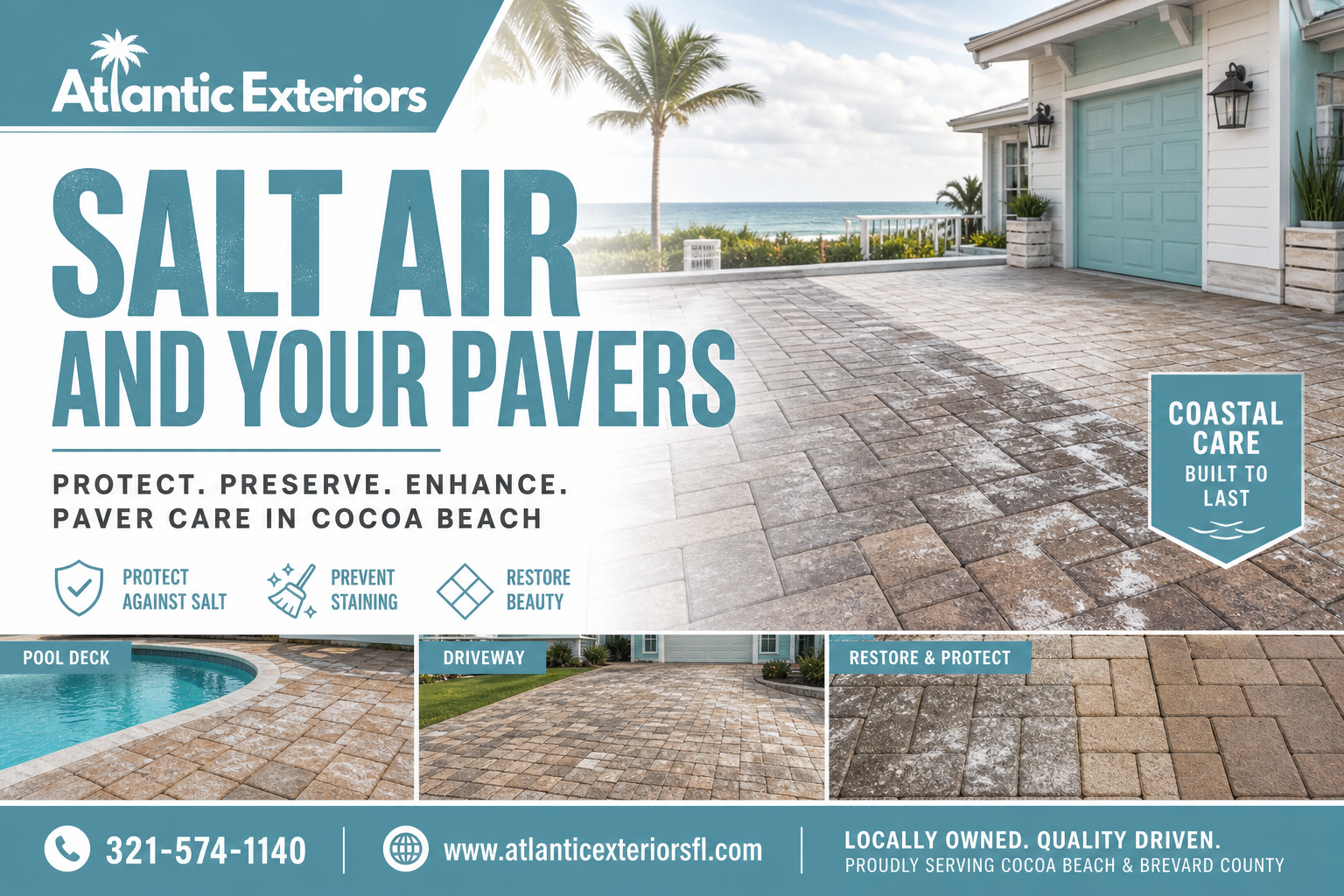
Cocoa Beach paver care: What salt air actually does
Living near the water in Cocoa Beach has its perks. Your pavers get a different kind of wear, though.
Salt air, humidity, strong sun, and afternoon thunderstorms all work together. Over time, that can change how your driveway, patio, walkway, or pool deck pavers look and hold up.
The good news is this. Salt air does not usually ruin pavers overnight. What it does is speed up the normal aging process, especially if the surface is unsealed or the joint sand is already wearing down.
That is where good Paver Sealing and regular inspection matter. At Atlantic Exteriors, Derek personally inspects every project and gives homeowners in Cocoa Beach and across Brevard County clear, straight answers. If you want to talk it through, call Derek directly at (321) 574-1140.
What salt air actually does to pavers
A lot of homeowners hear “salt air” and picture instant damage. Real life is usually more gradual.
Salt carried in the air can settle on the surface of your pavers. Add humidity, summer UV, rain, and regular foot or vehicle traffic, and that buildup can start to wear on the finish and the joints between pavers.
What you may notice first:
- Faded color
- A drier, chalkier look
- Joint sand thinning out faster
- More weed growth in joints
- Surface stains hanging around longer
- A rougher feel underfoot around pool deck pavers
The pavers themselves are often still structurally fine. The bigger issue is usually the protection layer, the joint stability, and how exposed the surface stays to Florida weather.
In places like Cocoa Beach, Cape Canaveral, Satellite Beach, Indian Harbour Beach, Indialantic, and Melbourne Beach, that coastal exposure tends to be stronger than inland areas like Viera or parts of West Melbourne. But even inland Brevard County homes still deal with humidity, pollen, thunderstorms, and strong sun.
Salt air is only part of the story
Salt air gets the blame, but it is rarely acting alone.
Florida pavers deal with:
- Intense sun and UV for much of the year
- Humid air that keeps surfaces damp longer
- Afternoon thunderstorms that soak and rinse the surface
- Hurricane season wind and debris
- Organic buildup from leaves, mulch, and nearby landscaping
- Pool splash-out on pavers near your pool
That combination is why Paver Sealing in Brevard County is not just about shine. It is about helping the surface resist everyday wear and helping the joints stay more stable.
Where homeowners usually see the damage first
On most coastal homes, the first signs show up in the most exposed areas.
Driveways often fade unevenly because they take full sun, rain, and tire traffic. Patios can lose color and start looking tired before homeowners realize the joint sand is thinning. Pool deck pavers usually age faster because they get wet often, then bake in the sun.
Around Cocoa Beach and Merritt Island, we also see pavers near the street or open side yards take more wind-driven exposure. In Melbourne, Palm Bay, Rockledge, Titusville, and Cocoa, the pattern can be a little different, but the same general rule applies: the more sun, moisture, and open exposure, the faster the wear.
What worn pavers can look like
You may notice:
- Color that looks washed out
- Small gaps opening at the joints
- Sand tracking after heavy rain
- More ant activity in loose joints
- Dark spots that seem harder to clean
- Pool deck pavers feeling more porous or dry
That does not always mean you need major restoration. Sometimes a timely Paver Sealing service, along with re-sanding and surface prep, is enough to get ahead of bigger problems.
If you are not sure what stage your pavers are in, Derek can walk you through it on the free inspection. Call Atlantic Exteriors at (321) 574-1140 and you can get an honest opinion without guesswork.
How Paver Sealing helps in coastal Brevard County
Paver Sealing helps by giving the surface a layer of protection and helping lock in joint sand. That matters in salt-air areas because the pavers are constantly exposed to moisture, sun, and airborne residue.
A properly maintained sealed surface is generally easier to keep clean. It also helps reduce how quickly water and everyday grime work into the paver face.
For many homeowners, the practical benefits are the big ones:
- Better color retention
- More stable joints
- Less washout after storms
- Easier routine upkeep
- A cleaner, more finished look
This is especially useful for pool deck pavers, where wet conditions are just part of the setting. In most cases, paver sealing around your pool lasts closer to about 2 years. Standard driveway and patio Paver Sealing often lasts around 2 to 3 years, while covered patios can sometimes stretch beyond 3.
No sealer lasts forever in Florida. Anyone telling you otherwise is not being straight with you.
Timing matters more than people think
One of the biggest mistakes homeowners make is waiting until the pavers look far gone.
When the color is badly faded and the joints have already lost a lot of sand, the work may move beyond simple sealing and into paver repair and restoration. That can still be handled, but it is better to catch things earlier.
Atlantic Exteriors provides a free on-site inspection, a written quote, and a post-project follow-up on every project. Derek personally inspects every job, and he is licensed and insured.
What homeowners in Cocoa Beach should do now
If you live near the coast, a little observation goes a long way.
Take a look at your pavers after rain. Check the joints. Notice whether color is uneven or if sand seems to be disappearing. Around your pool, pay attention to areas that stay damp longer or look worn faster than the rest.
A few smart habits help:
- Rinse away heavy surface residue when needed
- Keep leaves and planters from sitting on pavers too long
- Watch for joint sand loss after storms
- Trim back landscaping that traps moisture
- Have the surface inspected before wear gets advanced
Homeowners in Cocoa Beach, Melbourne, Palm Bay, Viera, Rockledge, Merritt Island, Satellite Beach, Indialantic, Indian Harbour Beach, Melbourne Beach, Cocoa, Cape Canaveral, Titusville, and West Melbourne all deal with Florida weather in slightly different ways. But the basic need is the same: protect the pavers before the climate does more of the aging for you.
If you want a straightforward opinion, call Derek directly at (321) 574-1140. He can tell you whether your pavers need Paver Sealing, minor restoration, or simply a little more time.
FAQ
Does salt air damage pavers in Cocoa Beach?
It can speed up wear, especially on unsealed pavers or where joint sand is already thinning. Usually, the effect is gradual and shows up as fading, surface dryness, and faster joint wear.
How often should pavers be sealed near the beach?
In most cases, Paver Sealing lasts about 2 to 3 years in Florida. Pavers near your pool are often closer to 2 years, while covered patios may last beyond 3 years depending on exposure.
Are my faded pavers beyond saving?
Not always. Many faded surfaces can still respond well to proper prep, re-sanding, and Paver Sealing. If repairs are needed, Derek can explain that during the free inspection.
Who should I call for Paver Sealing in Brevard County?
If you want owner-operated service and a clear answer, call Derek at Atlantic Exteriors at (321) 574-1140. You will get a free on-site inspection, a written quote, and practical guidance based on what your pavers actually need.
If your pavers in Cocoa Beach or anywhere in Brevard County are looking faded, dry, or worn from sun, humidity, and salt air, Atlantic Exteriors can help you sort out the next step. Visit https://www.atlanticexteriorsfl.com for more about the company, then call Derek directly at (321) 574-1140 for a free inspection and a written quote.