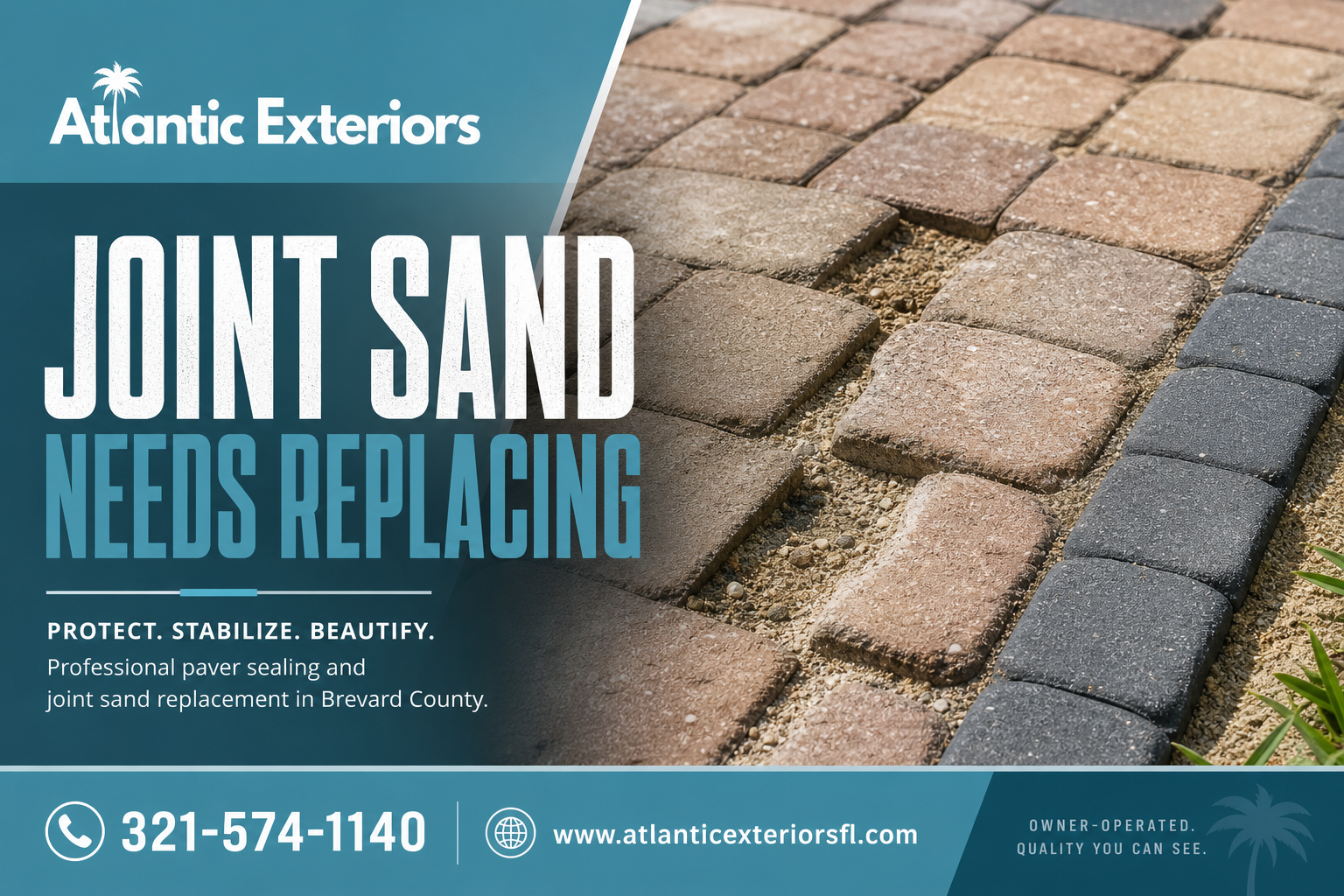
How to tell when your paver joint sand needs replacing
Brevard County pavers take a beating. On the Space Coast, sun, salt air, humidity, pollen, afternoon thunderstorms, and hurricane season all work on your driveway, patio, pool deck pavers, and walkways year after year.
One of the first things to wear down is the joint sand between the pavers. When that sand starts to fail, the surface can slowly become less stable and harder to maintain. If you live in Melbourne, Palm Bay, Viera, Rockledge, Merritt Island, Satellite Beach, Indialantic, Indian Harbour Beach, Melbourne Beach, Cocoa Beach, Cocoa, Cape Canaveral, Titusville, or West Melbourne, it helps to know what to look for.
At Atlantic Exteriors, Derek personally inspects every project. If you are unsure whether your joint sand is still doing its job, you can call Derek directly at (321) 574-1140 for a free on-site inspection and written quote.
What paver joint sand actually does
Joint sand is the material packed into the spaces between your pavers. It does more than fill gaps.
It helps:
- Keep pavers snug and better supported
- Reduce side-to-side movement
- Slow down weed growth
- Limit insect activity in the joints
- Help water move across the surface more evenly
- Support the results of Paver Sealing
When the sand level drops too low, the pavers can start shifting against each other. That is when small issues can turn into repair issues.
For homeowners, that might mean a driveway that starts feeling uneven underfoot or a patio that collects more debris in the joints. For commercial properties, it can mean worn-looking storefront and business-entrance pavers, HOA walkways that need attention, or parking lot paver sealing projects that should include restoration work first.
The most common signs your joint sand needs replacing
You do not need to be in the paver business to spot the warning signs. Most of them are easy to see once you know where to look.
The sand sits low in the joints
This is one of the clearest signs. If the sand looks sunken well below the top edge of the pavers, it may no longer be giving the joints enough support.
A little settling over time is normal. But when the joints look noticeably empty across large sections, it is usually time for a closer look.
You see sand washing out after heavy rain
On the Space Coast, summer storms can be rough on paver surfaces. If you notice sand collecting at the bottom of the driveway, near a drain, or along the edge of a patio after rain, that is a sign the joints are losing material.
This is especially common on sloped driveways and open pool deck pavers exposed to frequent rinsing and splash-out.
Weeds or moss keep coming back
Weed growth does not always mean the pavers were installed wrong. Often, it means the joints have opened up enough to hold debris and moisture.
If you keep seeing growth in the same areas, the joint sand may be too low, too loose, or breaking down. Paver repair & restoration may be needed before fresh Paver Sealing is applied.
Ants are working in the joints
Ants love loose, dry joint spaces. If you are seeing small sand piles or ant activity between pavers, the sand may have become weak or patchy.
That does not mean every ant problem is a major paver problem. But it is a good reason to have the surface inspected.
Pavers feel loose or sound hollow
Walk across the area and pay attention. Do any pavers rock slightly? Do they sound different from the surrounding area?
Loose movement can mean the joints are not holding the surface together the way they should. On a residential patio, that may be annoying. On a commercial paver sealing job, especially around entrances or shared walkways, it can become a bigger maintenance concern.
Why this happens faster in Brevard County
Florida weather is hard on exterior surfaces, and Brevard County adds a few local challenges.
Sun, rain, and humidity wear things down
Strong UV exposure dries surfaces out. Then afternoon thunderstorms soak them again. That cycle repeats for months.
Over time, joint sand can loosen, erode, or thin out. Humidity and damp conditions also help organic buildup collect in the joints.
Salt air can be rough near the coast
In places like Satellite Beach, Indian Harbour Beach, Indialantic, Melbourne Beach, Cocoa Beach, and Cape Canaveral, salt air adds another layer of wear. Coastal properties often need a little closer attention because everything outside faces more exposure.
Pool areas usually wear faster
Pavers around your pool often need attention sooner than covered areas. Splash-out, deck rinsing, sun exposure, and foot traffic all add up.
As a general rule, Paver Sealing often lasts around 2 to 3 years, while paver sealing around your pool is often closer to 2 years. Covered patios can sometimes stretch beyond 3 years. Joint sand wear tends to follow a similar pattern, though every surface is different.
When replacing joint sand makes sense
If the sand is low in a few small spots, a touch-up may be enough. If it is missing across broad sections, or if the pavers are shifting, a more complete restoration is usually the smarter route.
A proper inspection matters here. Derek can tell you whether your surface needs:
- Fresh joint sand in worn areas
- Paver repair and resetting first
- Cleaning and prep before re-sanding
- Full Paver Sealing after the joints are restored
That applies to small residential patios around 500 square feet and larger commercial jobs up to 20,000 square feet. Atlantic Exteriors handles both homeowners and businesses across the Space Coast, including commercial paver sealing for storefronts, HOA paths, courtyards, and business entrances.
If you want a clear answer without guesswork, call Derek directly at (321) 574-1140.
Should you replace joint sand before sealing?
In many cases, yes. Good Paver Sealing depends on the condition of the surface underneath, including the joints.
If the sand is already failing, sealing over the top does not fix the root issue. The pavers may still move, joints may still collect debris, and the finish may not hold up the way it should.
That is why Atlantic Exteriors starts with a free on-site inspection. Derek personally inspects every project, provides a written quote, and follows up after the work is done. The company is licensed and insured, and the goal is simple: give you an honest recommendation based on what your pavers actually need.
FAQ
How often does paver joint sand need replacing?
It depends on sun, rain, traffic, and location. In Brevard County, exposed areas often need attention around the same time as Paver Sealing, usually every 2 to 3 years, with pool deck pavers often needing it a bit sooner.
Can I just add sand on top of the old joints?
Sometimes, but not always. If the joints are contaminated, uneven, or the pavers have started moving, the surface may need restoration first. Derek can walk you through this on the free inspection.
Is missing joint sand a problem for commercial properties too?
Yes. Low or missing joint sand can affect storefront and business-entrance pavers, HOA walkways, courtyards, and parking areas. Commercial paver sealing works best when the joints are in good shape first.
How do I know if I need repair or just re-sanding?
The easiest way is to have it inspected in person. If your pavers are loose, uneven, or washing out badly, repair may be needed before re-sanding and sealing.
If your pavers in Melbourne, Palm Bay, Viera, Rockledge, Merritt Island, Titusville, or anywhere in Brevard County are showing these signs, Atlantic Exteriors can help. Call Derek directly at (321) 574-1140 or visit https://www.atlanticexteriorsfl.com to schedule your free on-site inspection. You will get a written quote, honest guidance, and a clear plan for the next step.