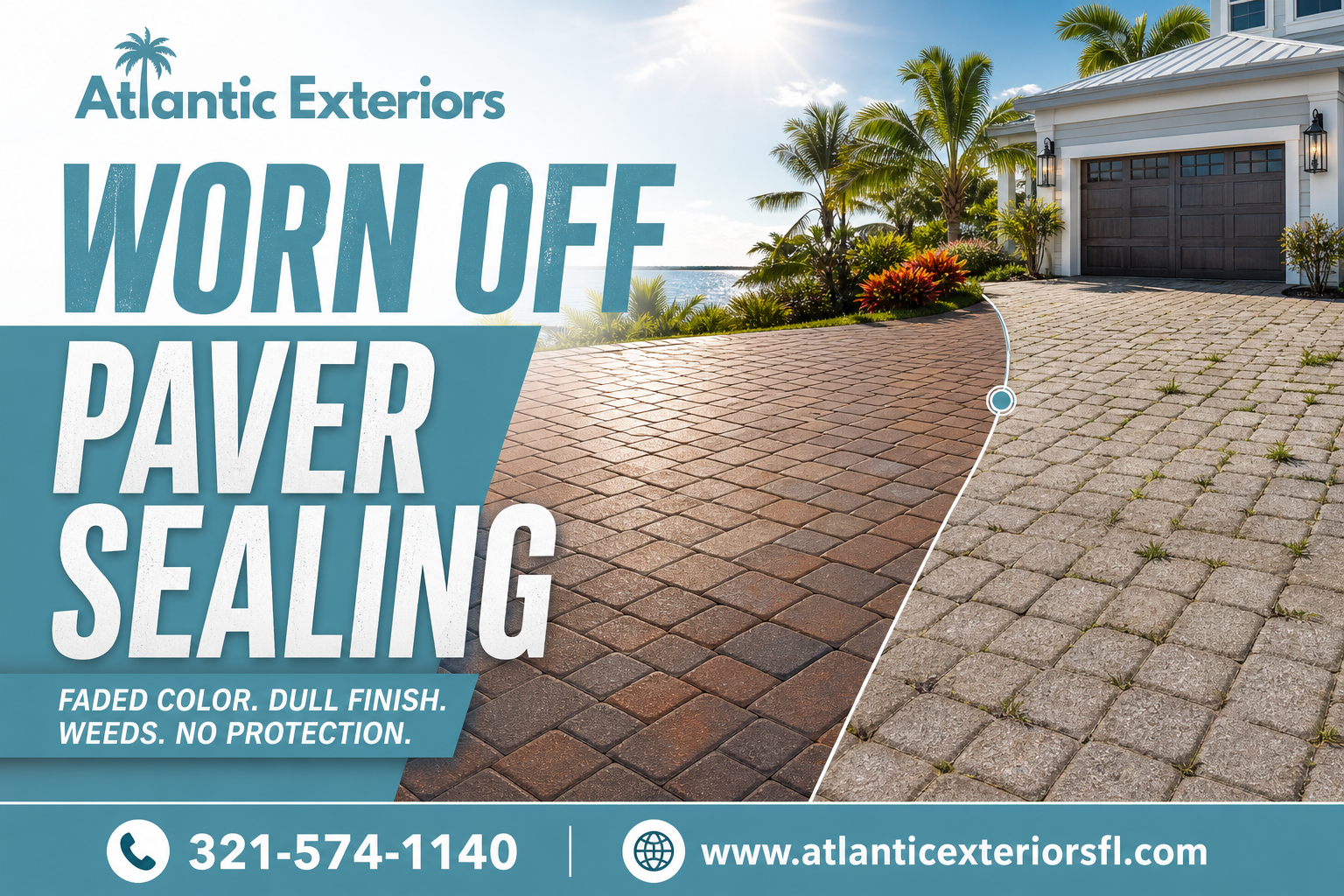
How to tell when your paver sealing has worn off
If your brick pavers looked rich in color a year or two ago but now seem dull, faded, or harder to clean, your paver sealing may be wearing off.
That is normal in Florida. Between strong sun, humidity, salt air, pollen, afternoon thunderstorms, and hurricane season, sealed pavers in Brevard County take a beating. The question is not whether sealer wears down. It is how to spot it before your pavers start looking tired or become harder to maintain.
At Atlantic Exteriors, Derek Perreira personally inspects every project. If you want a straight answer about your driveway, patio, walkway, or pavers near your pool, call Derek directly at (321) 574-1140.
The easiest signs your paver sealing is fading
Most homeowners do not notice sealer failing all at once. It usually happens little by little.
Here are the most common signs:
- The pavers look dry or chalky instead of rich and even
- Color enhancement has faded
- Water no longer beads on the surface
- Dirt seems to stick faster than it used to
- Weed growth or ant sand movement is becoming more noticeable in joints
- The surface feels rougher and less protected
- Pool deck pavers start looking worn sooner than covered areas
If you are seeing two or three of those at the same time, there is a good chance the original paver sealing is near the end of its life.
In places like Melbourne, Palm Bay, and West Melbourne, summer UV and heavy rain can speed that up. In beachside areas like Satellite Beach, Indialantic, Indian Harbour Beach, Melbourne Beach, Cocoa Beach, and Cape Canaveral, salt air can be especially hard on exterior surfaces.
Dull color is often the first clue
Many homeowners first notice the color change.
When paver sealing is fresh, the surface usually looks more even and the color has more depth. As the sealer wears off, pavers can start looking flat, faded, and uneven. Some sections may still look decent while high-traffic areas, like the center of a driveway or the path to the pool, look washed out.
That uneven look is a strong clue that protection has worn away in spots.
Watch how water behaves after rain or rinsing
One of the simplest ways to check your paver sealing is to look at water.
After a light rinse or one of our usual Florida afternoon thunderstorms, pay attention to whether water beads up or just soaks in quickly. A sealed surface often shows some water beading. When that effect is mostly gone, the sealer may be worn down.
This is not a perfect test by itself. Different pavers and different conditions can affect what you see. But it is a helpful sign.
Pool deck pavers usually wear faster
Pavers around your pool often lose protection sooner than a covered patio or a less exposed walkway.
That is because pool deck pavers deal with:
- Constant sun exposure
- Standing water and splash-out
- Foot traffic
- Humid conditions
- More frequent cleaning
In many cases, paver sealing around your pool lasts closer to 2 years. Covered patios can sometimes stretch beyond 3 years. For most open areas, 2 to 3 years is a realistic range in Brevard County.
If you live in Rockledge, Viera, Merritt Island, Cocoa, Titusville, or Melbourne and your pool deck pavers are starting to look tired around that timeline, it is worth having Derek take a look. Call (321) 574-1140 and he can walk you through it.
Harder cleaning is another red flag
When paver sealing is doing its job, routine debris is usually easier to blow off or rinse away. Once the sealer wears down, the surface tends to hold onto dirt, pollen, leaf marks, and everyday grime more easily.
That does not mean your pavers are ruined. It just means the protective layer may no longer be helping the way it should.
Homeowners often describe it like this: "It used to clean up nicely, and now it always looks dirty again."
That is a very common sign.
Look at the joints too
The pavers themselves are only part of the picture. The joints matter too.
If joint sand is thinning out, shifting, or allowing more weed growth or insect activity, that can point to worn protection. Florida rain and repeated washout can gradually affect the stability and appearance of the joints over time.
If the pavers feel loose, uneven, or you are noticing movement, that may be more than a sealing issue. It could be time for paver repair and restoration as well. Derek can walk you through this on the free inspection.
Why Florida conditions shorten sealer life
Brevard County is hard on exterior pavers.
You have summer UV, high humidity, heavy rain, salt air near the coast, pollen in spring, and long stretches of heat. Then hurricane season brings extra moisture and debris. All of that adds up.
That is why a timeline from another state often does not apply here. A homeowner in Merritt Island or Cocoa Beach may see wear sooner than someone with a covered lanai in Viera. A driveway in Palm Bay may age differently than pavers near the ocean in Satellite Beach.
The good news is that worn paver sealing is usually easy to spot once you know what to look for.
When to call for an inspection
If your pavers are around the 2 to 3 year mark, or sooner for pool deck pavers, it makes sense to have them checked.
Atlantic Exteriors provides:
- A free on-site inspection
- A written quote
- A post-project follow-up
- Licensed and insured service
- Owner-operated care from Derek Perreira
That matters because you are not getting a vague answer from a sales rep. Derek personally inspects every project and gives clear, honest feedback based on what your pavers actually need.
If you are in Melbourne, Palm Bay, Rockledge, Viera, Merritt Island, Satellite Beach, Indialantic, Indian Harbour Beach, Melbourne Beach, Cocoa Beach, Cocoa, Cape Canaveral, Titusville, or West Melbourne, call Derek directly at (321) 574-1140.
A quick homeowner rule of thumb
If your pavers look faded, soak up water faster, collect dirt more easily, or show joint issues, your paver sealing may be worn off.
You do not need to guess. A short on-site inspection can tell you whether it is time to reseal, touch up certain areas, or address repairs first.
FAQ
How long does paver sealing usually last in Florida?
Most paver sealing lasts about 2 to 3 years in Florida. Pavers near your pool are often closer to 2 years, while covered patios can sometimes last beyond 3 years.
Can pavers look fine in one area and worn off in another?
Yes. High-traffic areas, sunny spots, and exposed sections often wear faster than shaded or covered areas. That is very common on driveways and pool deck pavers.
Does faded color always mean I need new paver sealing?
Not always, but it is a common sign. Derek can check whether the issue is normal wear, joint sand loss, or a repair concern during the free inspection.
Who should I call in Brevard County for an honest inspection?
Call Derek at Atlantic Exteriors at (321) 574-1140. He personally inspects every project, provides a written quote, and can explain what your pavers need without overcomplicating it.
If you think your paver sealing has worn off, Atlantic Exteriors is here to help. Visit https://www.atlanticexteriorsfl.com for more about the company, then call Derek directly at (321) 574-1140 to schedule your free on-site inspection and get clear, honest guidance for your pavers.