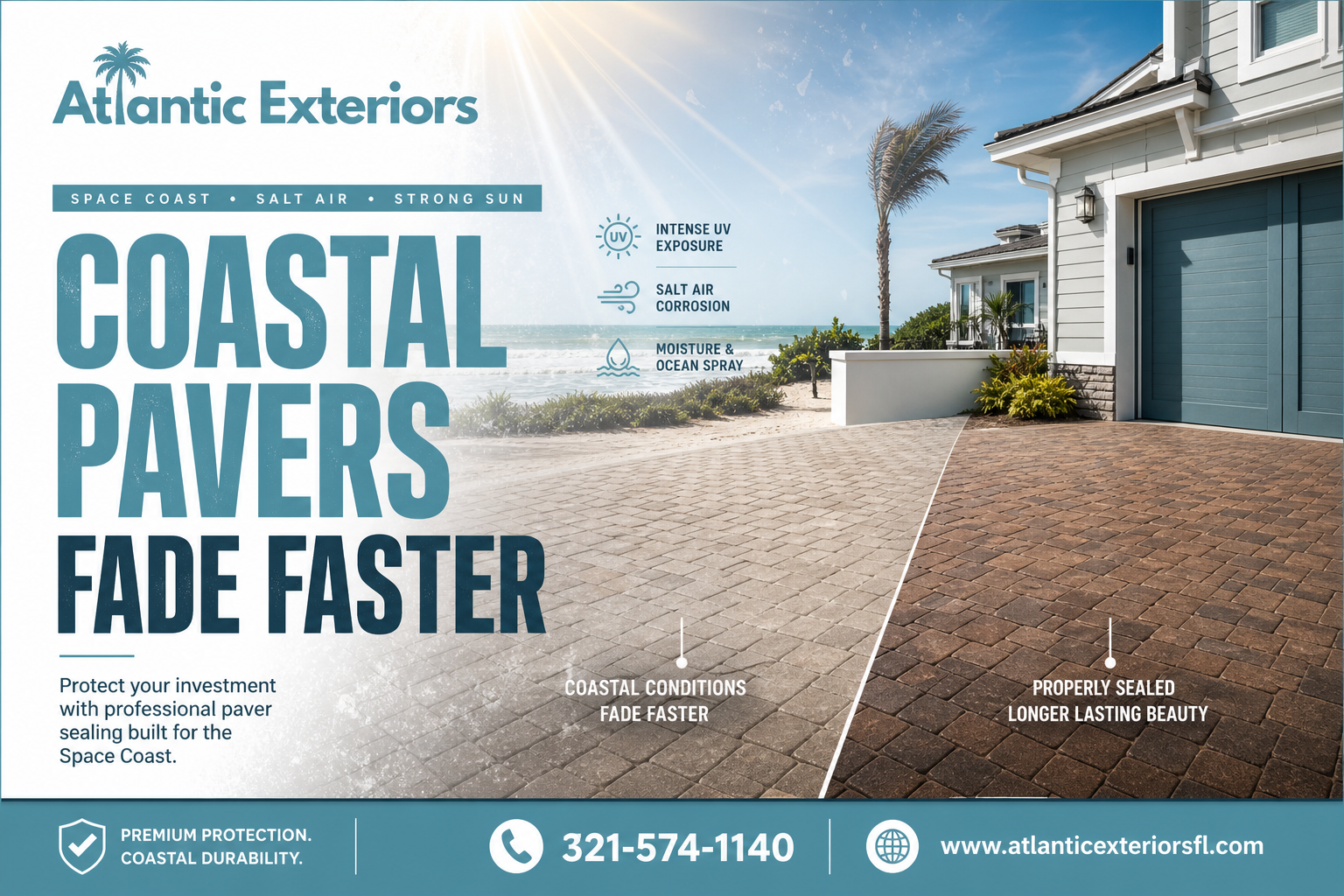
Why Indialantic and Satellite Beach pavers fade faster
Brevard County homeowners already know it: pavers near the ocean do not age the same way as pavers farther inland. On the Space Coast, homes in Indialantic, Satellite Beach, Indian Harbour Beach, Melbourne Beach, and Cocoa Beach usually see faster color fading than homes in Melbourne, Palm Bay, Viera, Rockledge, Merritt Island, Cocoa, Titusville, West Melbourne, or Cape Canaveral.
That does not mean beachside pavers are bad. It means they live in a tougher environment.
If your driveway, patio, walkway, or pool deck pavers look washed out sooner than you expected, there is a reason. And in many cases, regular Paver Sealing helps slow that wear and keep the surface looking more even over time. If you want a straight answer for your property, call Derek directly at (321) 574-1140.
Why beachside pavers take more abuse
The biggest difference is exposure. Inland homes still deal with heat, humidity, rain, and summer sun. But beachside homes add another layer: salt air.
Salt in the air settles on hard surfaces every day. Over time, that constant exposure can dry out the look of pavers and wear on the sealer faster than many homeowners expect.
Then add the rest of Brevard County weather:
- strong summer UV
- afternoon thunderstorms
- high humidity
- wind-driven sand
- hurricane season exposure
- heavy pollen in certain months
All of that builds up on the surface. It also means pavers in Indialantic and Satellite Beach often need more attention than the same style of pavers in Viera or Rockledge.
Sun hits beachside areas harder than most people think
Florida sun is tough everywhere, but open coastal lots often have less shade. Many beachside driveways and pool areas sit in direct sun for long stretches.
That matters because UV exposure is one of the main reasons pavers lose that richer, deeper color and start looking flat. Darker pavers usually show this first, but lighter blends can fade too.
Salt air, sand, and moisture speed up wear
Salt air does not usually show up as one dramatic problem. It is more of a steady, everyday stress.
A beachside paver surface is often dealing with fine salt residue, blowing grit, and moisture cycling all at once. Humid mornings, hot afternoons, and sudden rainstorms create a repeat pattern that slowly wears on the finish.
For homeowners, this often shows up as:
- color fading sooner
- a drier, chalkier appearance
- uneven areas where some pavers fade faster than others
- sealer wearing out sooner than expected
Pool deck pavers near the coast can be even more exposed. Between sun, moisture, foot traffic, and occasional splash-out, paver sealing around your pool often has a shorter life than a covered patio. In general, paver sealing lasts about 2 to 3 years, with pool deck pavers often closer to 2 years and covered areas sometimes stretching beyond 3.
If you are not sure where your pavers stand, Derek personally inspects every project. Atlantic Exteriors provides a free on-site inspection, a written quote, and a post-project follow-up. You can call Derek at (321) 574-1140 to set that up.
Why inland homes often keep color longer
Homes in Melbourne, Palm Bay, West Melbourne, Viera, and Rockledge are still dealing with Florida weather, but many inland properties get a small break from the constant salt-air exposure.
That does not make inland pavers maintenance-free. It just means the fading process is often slower and more predictable.
A driveway in Merritt Island or Cocoa may still fade from UV and rain. A patio in Titusville may still lose color over time. But beachside surfaces in Satellite Beach or Indialantic usually show wear earlier, especially if they are wide open to sun and wind.
It is not only about age
Many people assume fading means the pavers are simply old. Sometimes that is true. But location matters just as much.
A newer beachside paver driveway can look more weathered than an older inland one if it has been taking direct sun, salt air, and storm exposure from day one.
That is why local experience matters. A company working in Brevard County should understand the difference between maintaining pavers in Melbourne and maintaining them in Melbourne Beach.
How Paver Sealing helps slow fading
Paver Sealing does not stop weather. Nothing does. But it does help protect the surface and preserve color longer than leaving pavers bare.
A properly maintained sealed surface is better able to handle everyday exposure from sun, moisture, and traffic. It also helps pavers look more uniform and easier to maintain.
For many homeowners, the right time to reseal is before the pavers look badly worn. Waiting too long can mean the color has already flattened out more than you wanted.
Signs it may be time for a free inspection include:
- pavers look dull even after cleaning
- color appears uneven
- water no longer behaves the same on the surface
- sand joints seem to be wearing down
- your last sealing was a few years ago
Derek can walk you through what makes sense on the free inspection without overcomplicating it.
What this means for commercial properties and HOAs
The same beachside conditions affect commercial paver sealing too. Storefront and business-entrance pavers, HOA walkways, courtyards, and parking lot paver sealing areas near the coast often fade faster than similar surfaces inland.
For property managers and business owners, appearance matters. Faded pavers can make an entrance look older than it is.
Atlantic Exteriors handles both small and large projects across Brevard County, from residential patios around 500 square feet to larger commercial jobs up to around 20,000 square feet. That includes HOA and property-manager paver sealing, storefront entrances, walkways, and larger shared-use surfaces.
If you manage a property in Satellite Beach, Indialantic, Indian Harbour Beach, or Cocoa Beach, it helps to plan for a more active maintenance cycle than you might use for a site in inland Melbourne or Palm Bay.
The best next step for beachside pavers
The smartest move is not guessing. It is having the surface looked at by someone who works on Space Coast pavers every day.
Atlantic Exteriors is licensed and insured, and Derek brings more than 15 years of paver experience to each project. He works with homeowners and commercial clients across Brevard County, and he personally inspects every job.
If your pavers are fading faster than expected in Indialantic, Satellite Beach, Melbourne Beach, or anywhere else on the Space Coast, call Derek directly at (321) 574-1140. You can also learn more at https://www.atlanticexteriorsfl.com, but the easiest next step is a phone call. Derek will set up a free on-site inspection, provide a written quote, and follow up after the project.
FAQ
Why do pavers fade faster near the beach?
Mostly because of constant sun, salt air, humidity, wind, and storm exposure. Beachside pavers usually face more daily stress than inland pavers.
How long does paver sealing last in Brevard County?
Most paver sealing lasts around 2 to 3 years. Pool deck pavers are often closer to 2 years, while covered patios can sometimes last beyond 3.
Can faded pavers be improved, or do they need replacement?
Often, paver sealing and restoration can improve the look of faded pavers. The right answer depends on the condition of the surface, and Derek can explain that during the free inspection.
Does Atlantic Exteriors handle commercial paver sealing too?
Yes. Atlantic Exteriors works on residential and commercial paver sealing projects, including driveways, patios, walkways, storefronts, HOA areas, and larger parking-area pavers across Brevard County. For scheduling, call Derek directly at (321) 574-1140.