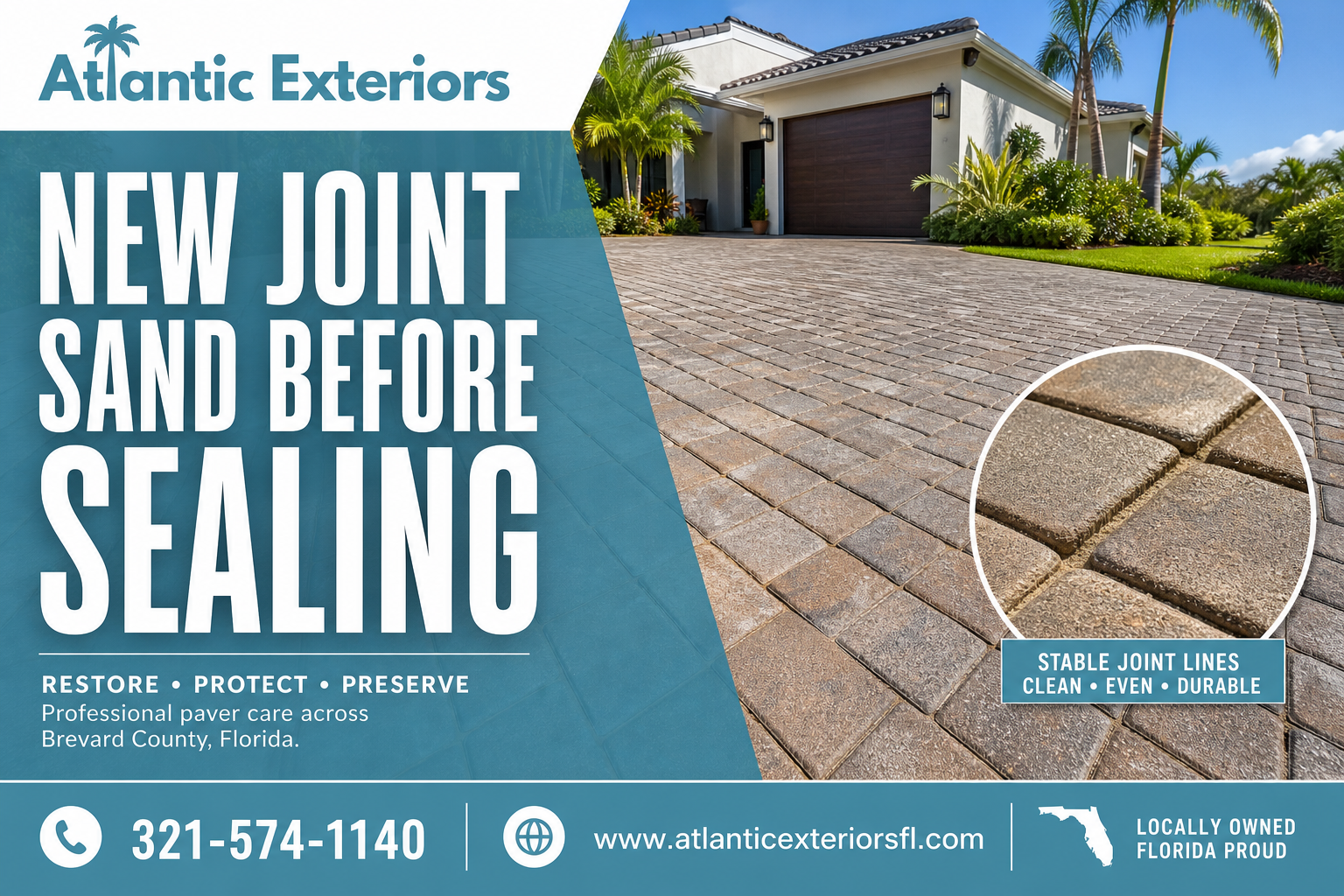
Why your driveway may need new joint sand before sealing
Brick paver driveways in Brevard County take a beating. Sun, heavy rain, humidity, salt air, pollen, and afternoon thunderstorms all work on the surface and the joints between the pavers.
That is one reason some driveways need new joint sand before Paver Sealing. If the joints are low, washed out, or uneven, sealing over them is usually not the right move.
At Atlantic Exteriors, Derek personally inspects every project before giving a recommendation. Sometimes a driveway is ready for cleaning and Paver Sealing. Sometimes it needs fresh joint sand first. If you want a clear answer for your home in Melbourne, Palm Bay, Viera, or anywhere in Brevard County, call Derek directly at (321) 574-1140.
What joint sand actually does
Joint sand is the sand swept into the spaces between your pavers. It may not look like much, but it does important work.
It helps:
- Support the edges of each paver
- Reduce shifting over time
- Fill gaps where water can move through
- Help keep the surface more stable under traffic
- Improve the finished look before Paver Sealing
When the sand level drops too low, the pavers can lose some of that support. You may start to notice wider gaps, uneven lines, small movement, or areas that just look tired.
On a driveway, this matters even more because of vehicle weight. A patio or walkway sees lighter use. A driveway in West Melbourne, Rockledge, or Titusville deals with cars, turning tires, and regular wear.
Why old joint sand often needs to be replaced
Florida weather is hard on paver joints. Even a well-installed driveway can lose sand over time.
Rain and washout
Brevard County gets strong summer storms. Water can move sand out of the joints little by little, especially near slopes, edges, or low spots.
Pressure and traffic
Every time a car drives in and out, the joints take stress. Over the years, that movement can loosen and reduce the sand between the pavers.
Previous cleaning or poor maintenance
If a driveway was cleaned too aggressively in the past, some of the joint sand may have been removed. That leaves the surface looking cleaner for the moment, but less prepared for proper Paver Sealing.
Florida sun and exposure
UV, heat, humidity, and salt air all add up. In places like Satellite Beach, Indialantic, Indian Harbour Beach, Cocoa Beach, and Cape Canaveral, coastal exposure can be especially tough on outdoor surfaces.
Why sealing without enough joint sand can be a problem
A lot of homeowners assume sealer is the main protection. Sealer is important, but it is not a substitute for properly filled joints.
If the sand is missing or too low, sealing can leave you with:
- A driveway that still looks uneven
- Less support between pavers
- More visible gaps after the job is done
- A shorter-lived result in problem areas
- Existing movement issues that were never addressed
In plain terms, Paver Sealing works best when the surface underneath is properly prepared. That includes the joints.
Derek will tell you directly if your driveway needs fresh joint sand first. He does not guess from photos alone. He offers a free on-site inspection, a written quote, and a post-project follow-up. To talk it through, call Atlantic Exteriors at (321) 574-1140.
Signs your driveway may need new joint sand
You do not need to be an expert to spot the basics. Here are a few common signs.
The joints look low
If the sand sits noticeably below the top edge of the pavers, that is a sign the joints may need attention before sealing.
You see empty gaps
Small open spaces between pavers are a red flag. Those gaps can collect debris, hold moisture, and allow more movement.
Sand keeps washing out
If you notice sand after storms or see the joints thinning out year after year, replacement may be needed.
Pavers feel loose or sound different
A little movement underfoot or a slight rattle can point to reduced joint support. That does not always mean a major repair, but it should be checked.
The driveway has not been serviced in years
Most Paver Sealing in Florida lasts around 2 to 3 years, depending on exposure and use. Pool deck pavers are often closer to 2 years. Covered areas can last beyond 3. If your driveway in Merritt Island, Cocoa, Melbourne Beach, or Palm Bay has gone well past that window, the joints may need fresh sand as part of the restoration.
What Atlantic Exteriors looks at before Paver Sealing
Every driveway is different. Derek personally inspects the condition of the pavers, the joints, and the overall surface.
He may check for:
- Sand loss across the field of the driveway
- Heavier washout near edges or drains
- Minor shifting or settling
- Weed or debris buildup in open joints
- Surface wear from sun, rain, and traffic
- Whether the driveway is a good candidate for sealing now or needs prep first
If a repair issue is found, Derek can walk you through this on the free inspection. Atlantic Exteriors handles paver repair and restoration as well, when needed.
That straightforward inspection matters. A driveway in Viera may have different needs than one in Satellite Beach or Cocoa Beach because of sun, salt, and drainage patterns. The goal is not to oversell anything. The goal is to do the prep that helps the Paver Sealing hold up better.
What homeowners can expect from the process
If your driveway needs new joint sand, that step is handled before sealing. The idea is simple: clean the surface, restore what is missing in the joints, and then move forward with Paver Sealing when the driveway is ready.
That helps the finished job look more even and perform better in Florida conditions like hurricane season rain, summer UV, humidity, and pollen.
Atlantic Exteriors is licensed and insured, and every project includes:
- A free on-site inspection
- A written quote
- Clear recommendations in plain language
- A post-project follow-up
If you are in Melbourne, Rockledge, Titusville, West Melbourne, or nearby, you can call Derek directly at (321) 574-1140. You will get an honest opinion about whether your driveway needs fresh joint sand before Paver Sealing.
FAQ
How do I know if my driveway needs new joint sand before sealing?
If the joints look low, empty, or uneven, that is a common sign. Loose pavers, repeated washout, or long gaps between service visits can also point to the need for fresh sand. Derek can confirm it during a free inspection.
Can you seal pavers if some joint sand is missing?
Sometimes small areas are manageable, but in many cases low or missing joint sand should be corrected first. Sealing is usually best after the joints are properly filled and the surface is ready.
How long does Paver Sealing last in Brevard County?
Most driveway Paver Sealing lasts about 2 to 3 years in Florida. Pavers near your pool are often closer to 2 years because of water and sun exposure. Covered patios can sometimes go beyond 3 years.
Who should I call for driveway Paver Sealing in Brevard County?
Call Derek at Atlantic Exteriors at (321) 574-1140. He personally inspects every project and can tell you if your driveway in Brevard County is ready for sealing or needs new joint sand first.
If your driveway looks faded, the joints look low, or you are not sure what it needs, Atlantic Exteriors can help. Visit https://www.atlanticexteriorsfl.com for more about the company, then call Derek directly at (321) 574-1140 to schedule your free on-site inspection. A quick phone call is the easiest way to get a clear answer.