Why slip-safe sealer matters for pool area pavers
Pool areas look great with brick pavers. But around a pool, looks are only part of the job.
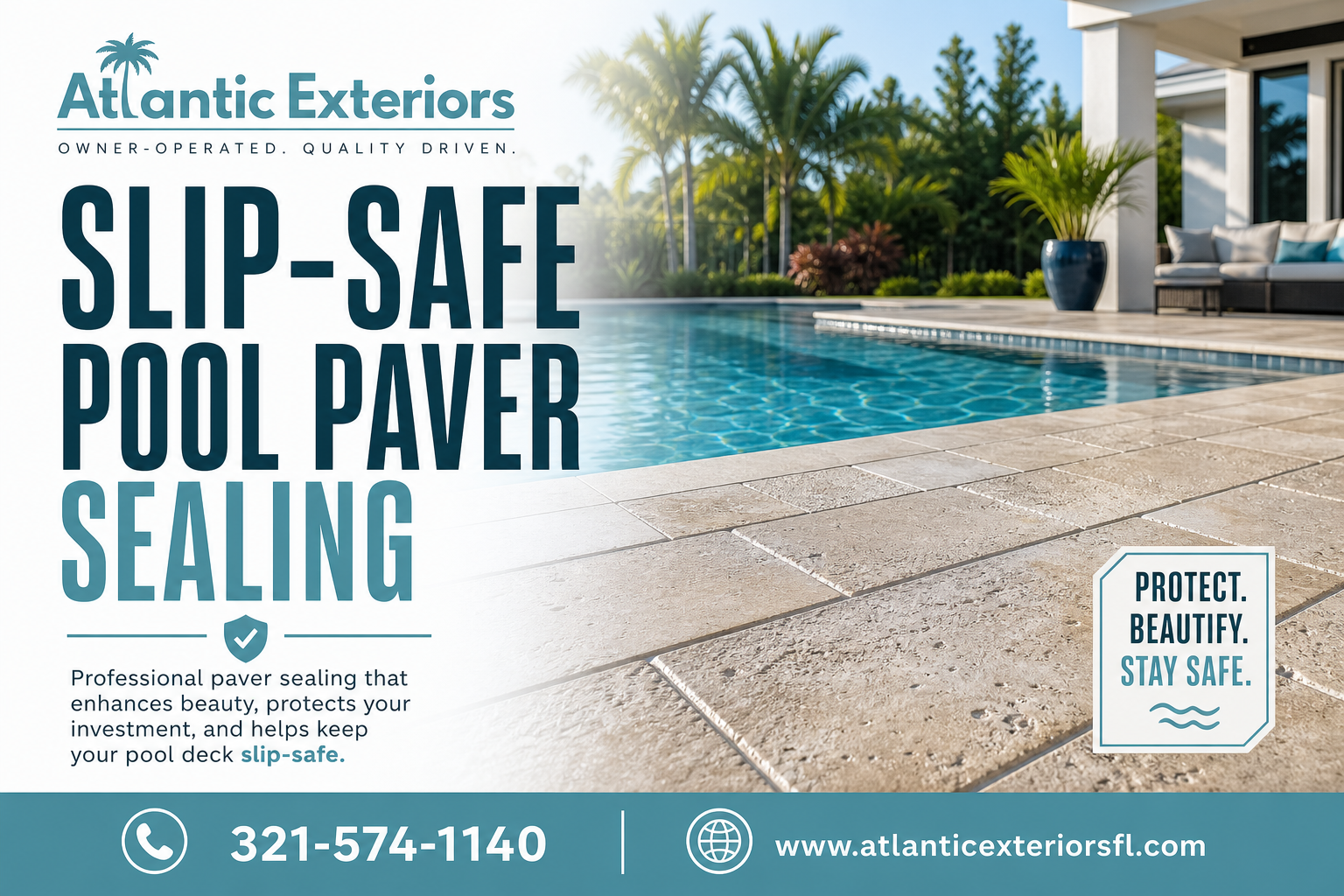
When pavers stay wet, safety matters. Bare feet, splashing kids, afternoon thunderstorms, and Florida humidity can all make the surface more challenging. That is why Atlantic Exteriors uses slip-safe sealer for pavers in pool areas.
This is still Paver Sealing. The goal is to protect the pavers, improve how they hold up, and help maintain better footing around the pool without creating an overly slick finish. If you live in Melbourne, Palm Bay, Viera, Rockledge, Merritt Island, or nearby parts of Brevard County, Derek can walk your pool deck with you and explain what makes sense for your specific pavers. You can call Derek directly at (321) 574-1140.
Pool area pavers have different demands
Pavers near a pool deal with more than a driveway or even a standard patio.
They get regular water exposure. They also see sunscreen, pollen, leaves, salt air in coastal areas like Satellite Beach, Indialantic, Indian Harbour Beach, Melbourne Beach, Cocoa Beach, and Cape Canaveral, plus strong summer UV and heavy rain during hurricane season.
That combination matters.
A sealer that looks fine in one area may not be the right fit around a pool. Some finishes can leave the surface feeling too slick when wet. That is exactly what most homeowners want to avoid.
At Atlantic Exteriors, Derek personally inspects every project. He looks at the paver condition, the location, drainage, sun exposure, and how the area is used. Then he recommends the right Paver Sealing approach for that pool area.
Every project includes:
- A free on-site inspection
- A written quote
- A post-project follow-up
Atlantic Exteriors is also licensed and insured, which gives homeowners added peace of mind.
Why we use slip-safe sealer for pavers in pool areas
The simple answer is safety.
Around a pool, the pavers are going to get wet. People are stepping out of the water, walking barefoot, carrying towels, or moving quickly to grab something. A pool deck should not feel overly glossy or slick.
A slip-safe sealer is chosen to help avoid that problem while still giving you the benefits of Paver Sealing.
The goal is traction, not a shiny coating
Many homeowners assume all sealer does the same thing. It does not.
For pool deck pavers, Atlantic Exteriors focuses on a finish that helps preserve a more natural, safer feel underfoot. That usually means avoiding the kind of heavy, high-gloss look that can be less practical around standing water.
Derek can walk you through this on the free inspection if you want to compare finish options.
It still protects the pavers
Using a slip-safe sealer does not mean giving up protection.
Proper Paver Sealing around your pool can help with:
- Slowing surface wear from sun and weather
- Reducing how quickly the pavers fade in Florida UV
- Helping limit water intrusion
- Stabilizing joint sand
- Making routine cleanup easier
- Improving the overall finished look without overdoing the shine
That balance is what most homeowners want. They want the pavers protected, but they also want the area comfortable and practical for everyday use.
Florida weather is hard on pool deck pavers
In Brevard County, pool areas stay exposed year-round.
We get intense sun, high humidity, frequent rain, summer storms, and in many areas, salt air. Even inland cities like West Melbourne, Cocoa, Titusville, and Palm Bay still deal with plenty of moisture and heat. Closer to the coast, that exposure can be even tougher.
Pool deck pavers usually need more attention than covered areas.
As a general rule, Paver Sealing often lasts around 2 to 3 years. Around pools, it is commonly closer to 2 years because of the extra water, foot traffic, sun, and cleaning needs. Covered patios can sometimes stretch beyond 3 years.
That does not mean your pool pavers are failing at the 2-year mark. It means pool areas simply live a harder life, and they usually benefit from a maintenance-minded approach.
Why resealing timing matters
If sealer wears down too far, the pavers can become more vulnerable to fading, joint sand loss, and general weathering.
That is why a periodic inspection is helpful. Derek personally inspects every project, and he can tell you whether your pool deck pavers are ready for maintenance now or still have time left.
If you are unsure, call Derek directly at (321) 574-1140 and set up a free on-site inspection.
Slip-safe does not mean rough or unattractive
Some homeowners hear “slip-safe” and picture a harsh, gritty surface.
That is not the goal.
Good Paver Sealing around your pool should still look clean and finished. The pavers should feel well cared for. The color should look more even and refreshed. But the finish should also make sense for a wet area.
This is especially important for established homes in places like Melbourne, Viera, Rockledge, Merritt Island, and Indian Harbour Beach, where homeowners want the pool area to look sharp without becoming flashy or hard to walk on.
Atlantic Exteriors takes a practical approach. Derek is not trying to sell you the glossiest finish possible. He is trying to recommend what works best for your pool deck pavers in real Florida conditions.
The right process matters as much as the product
A slip-safe sealer only works well when the prep and application are handled correctly.
That includes evaluating the pavers first, cleaning them properly, checking the joints, and making sure the surface is ready before sealer goes down. If repairs or restoration are needed first, that should be addressed before sealing.
That is one reason homeowners like working with an owner-operated company. You are not getting a one-size-fits-all answer.
Derek has more than 15 years of paver experience, and he personally inspects every project. If your pool deck has worn areas, loose pavers, joint sand issues, or past sealer buildup, he can explain what he sees in plain language. No jargon. No pressure.
For homeowners in Satellite Beach, Melbourne Beach, Cocoa Beach, Cape Canaveral, or anywhere in Brevard County, that local experience matters. Florida sun, salt air, pollen, and afternoon thunderstorms all affect how pavers age and how Paver Sealing should be approached.
When to ask for a pool area paver inspection
It may be time to have Derek take a look if you notice:
- Your pool deck pavers look faded or dry
- Joint sand is washing out
- Water no longer beads the way it used to
- The surface feels different than before
- The finish looks uneven
- You are not sure what product was used last time
- You want to improve the look without making the area too slick
A free inspection is the easiest place to start. Derek will look at the pavers, explain what he recommends, and provide a written quote. Then after the work is done, Atlantic Exteriors follows up.
If you want straightforward advice about Paver Sealing around your pool, call Derek directly at (321) 574-1140.
FAQ
Does slip-safe sealer make pool pavers completely slip-proof?
No surface can be promised as completely slip-proof. The goal is to use a sealer that helps maintain better footing for wet pool areas while still protecting the pavers.
How long does Paver Sealing last around a pool?
In most cases, pool deck pavers are closer to about 2 years, while many other paver areas last 2 to 3 years. Covered spaces can sometimes last longer.
Can you seal older pool deck pavers?
Often, yes. It depends on the condition of the pavers and whether repairs or restoration should happen first. Derek can walk you through this on the free inspection.
Do you service all of Brevard County?
Atlantic Exteriors serves homeowners across Brevard County, including Melbourne, Palm Bay, Viera, Rockledge, Merritt Island, Satellite Beach, Indialantic, Indian Harbour Beach, Cocoa, Cocoa Beach, Cape Canaveral, Titusville, West Melbourne, and Melbourne Beach.
If you are thinking about Paver Sealing around your pool, Atlantic Exteriors is happy to help. Visit https://www.atlanticexteriorsfl.com to learn more, then call Derek directly at (321) 574-1140 for a free on-site inspection and written quote. He will personally look at your pavers, explain the options clearly, and help you choose a finish that makes sense for your home.