Tree roots and paver driveways: Florida damage signs
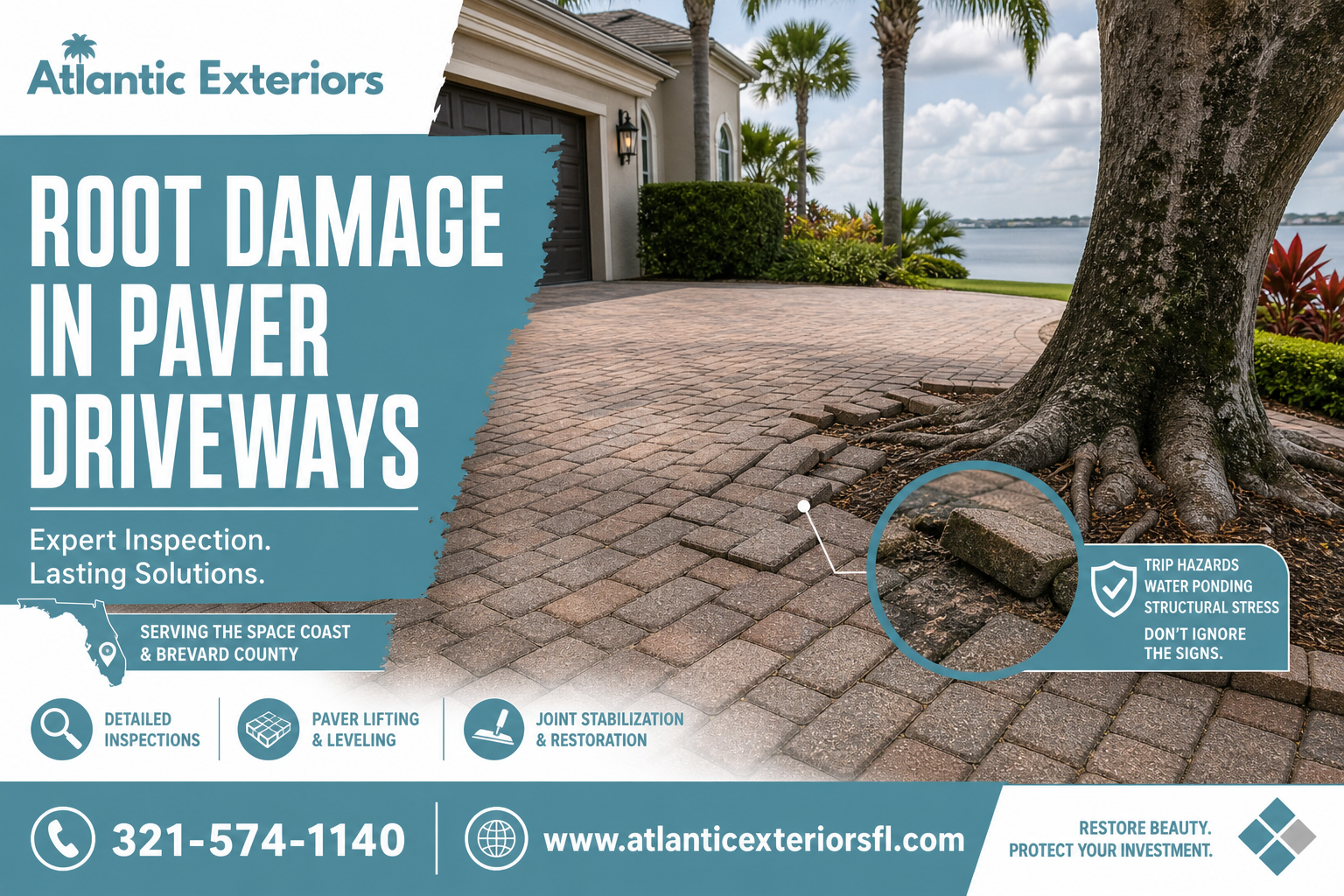
Brevard County homeowners and property managers see it all the time: a paver driveway looks fine from the street, then one day a small raised edge shows up near a tree line. A few months later, more pavers start shifting. On the Space Coast, from Melbourne and Palm Bay to Viera, Rockledge, Merritt Island, and Titusville, tree roots can quietly cause real damage before most people realize what is happening.
That matters because root damage usually starts small. It may look like a minor trip edge, a low spot, or a few joints opening up. But left alone, it can turn into a wider repair. If you want a clear opinion on what you are seeing, call Derek directly at (321) 574-1140. Atlantic Exteriors provides free on-site inspections for paver sealing and paver repair & restoration across Brevard County.
Why tree roots are hard on paver driveways
Paver driveways are flexible by design. That is one reason they work well in Florida conditions. But they still depend on a stable base underneath. When tree roots grow under or alongside the driveway, they can slowly push that base upward or sideways.
The problem is not always one giant root. Often it is a network of smaller roots spreading toward moisture and air. Over time, that root growth can:
- Lift sections of pavers
- Create uneven areas or humps
- Open the joints between pavers
- Let sand wash out faster during afternoon thunderstorms
- Cause edging to move or separate
- Create trip hazards near walkways and driveway borders
On the Space Coast, humidity, heavy rain, summer UV, and hurricane season all add stress. Once pavers shift, water does not always drain the same way. That can make the area wear faster.
Common warning signs in Brevard County driveways
In established neighborhoods in West Melbourne, Indialantic, Indian Harbour Beach, Satellite Beach, Cocoa, and Cape Canaveral, root issues often show up in older landscapes with mature trees. The driveway may still look mostly good, but a few signs usually appear early.
You notice one raised row or a slight ridge
This is one of the most common clues. A line of pavers may sit a little higher than the rest. It might not seem urgent, but it often means roots are pressing from below.
Joints keep opening back up
If sand loss keeps returning in one specific area, the pavers may be moving. Sealing helps protect and stabilize pavers, but paver sealing is not meant to hide active root movement. The underlying issue needs to be looked at first.
Water starts pooling where it did not before
When roots change the grade, water can collect in low spots or run in a new direction. In Florida, standing water and repeated washout can speed up wear on both residential and commercial surfaces.
The driveway edge starts spreading outward
Sometimes the root pressure is not straight up. It pushes from the side. That can affect borders, soldier courses, and transitions into sidewalks or garage slabs.
Why this is more than a cosmetic issue
A lifted driveway is not just about appearance. For homeowners, it can become a safety issue for family members and guests. For HOAs, storefronts, restaurants, and other commercial properties, uneven pavers can create a liability concern at entrances and walkways.
This is where owner-operated service matters. Derek personally inspects every project, whether it is a smaller residential driveway or a larger commercial paver sealing and restoration job. Atlantic Exteriors handles everything from modest patio areas to larger HOA walkways, storefront entrances, and parking lot paver sealing projects up to around 20,000 square feet.
If you manage a business property in Melbourne Beach, Cocoa Beach, or Merritt Island and you are seeing movement near landscaped islands or entry trees, call Derek directly at (321) 574-1140. A free inspection can help you understand whether you are dealing with root pressure, washout, or both.
What can be done about root-related paver damage
The right fix depends on how far the movement has gone. This is one of those cases where guessing can make things worse. Cutting roots without a plan can affect the tree. Resetting pavers without addressing the cause can mean the same area moves again.
Step 1: Inspect the pattern of movement
A good inspection looks at more than the raised pavers. It also looks at:
- Nearby trees and planting beds
- Drainage patterns
- Edge restraint condition
- Sand loss in the joints
- How far the affected area extends
Derek can walk you through this on the free inspection and give you a written quote for the work that makes sense.
Step 2: Repair and reset the affected area
In many cases, the damaged section needs to be lifted, the base corrected as needed, and the pavers reset. If root growth is still active, the repair plan needs to account for that. The goal is a stable surface, not a quick patch.
Step 3: Re-sand and seal when appropriate
After repairs, paver sealing can help protect the surface and joint sand from rain, sun, and daily wear. It also helps bring back a cleaner, more finished look. For most paver sealing projects in Brevard County, that protection typically lasts about 2 to 3 years, while pavers around your pool are often closer to 2 years because of the extra moisture and exposure.
If the driveway is simply dirty or faded but not moving, paver sealing may be the main need. If roots are actively lifting the field, repair comes first.
Trees, roots, and commercial properties
Homeowners are not the only ones dealing with this. Commercial and HOA properties often have decorative trees near entrances, medians, and sidewalks. Those areas can look great when installed, but years later they may start affecting storefront and business-entrance pavers.
For property managers, the challenge is usually balancing appearance, safety, and maintenance budgets. A small ridge at a restaurant entry in Viera or a shifted walkway at an HOA in Rockledge may not seem major at first. But once water starts pooling or more joints open, the repair area can grow.
That is why regular inspection matters. Atlantic Exteriors works on both residential and commercial paver sealing, including HOA and property-manager paver sealing, storefront areas, walkways, and parking lot paver sealing. Derek personally inspects each project and follows up after the work is complete.
How to lower the risk going forward
You cannot stop trees from growing, but you can catch problems earlier.
A few practical steps help:
- Watch for slight lifting near tree lines and islands
- Check after heavy summer rains and hurricane season
- Keep an eye on drainage changes
- Do not assume every uneven area is just settling
- Schedule periodic inspections for older paver surfaces
- Re-seal on a sensible cycle to help protect the surface and joints
Atlantic Exteriors is licensed and insured, and every project includes a free on-site inspection, a written quote, and a post-project follow-up. If you are unsure whether your driveway needs paver repair, paver sealing, or both, call Derek directly at (321) 574-1140.
FAQ
Can paver sealing stop tree roots from lifting my driveway?
No. Paver sealing helps protect the surface and joint sand, but it does not stop active roots from pushing underneath the pavers. If the driveway is moving, the cause needs to be inspected first.
How do I know if it is root damage or normal settling?
A raised ridge, movement near a tree, repeating joint separation, or a new drainage problem can point to root pressure. Derek can assess the pattern during a free on-site inspection.
Should I cut the roots myself?
That depends on the tree, the root size, and how close it is to the driveway. Cutting roots without a plan can affect the tree or lead to more movement. It is better to have the area evaluated first.
Do you handle both small homes and larger commercial properties?
Yes. Atlantic Exteriors works on everything from smaller residential paver areas to larger commercial jobs, including HOA walkways, storefront entrances, and parking areas. If you are in Melbourne, Palm Bay, Viera, Titusville, or elsewhere in Brevard County, call Derek directly at (321) 574-1140.
If tree roots are starting to affect your paver driveway, patio, walkway, or business entrance, Atlantic Exteriors can take a close look and give you a clear, honest recommendation. Visit https://www.atlanticexteriorsfl.com, then call Derek directly at (321) 574-1140 to schedule your free inspection.