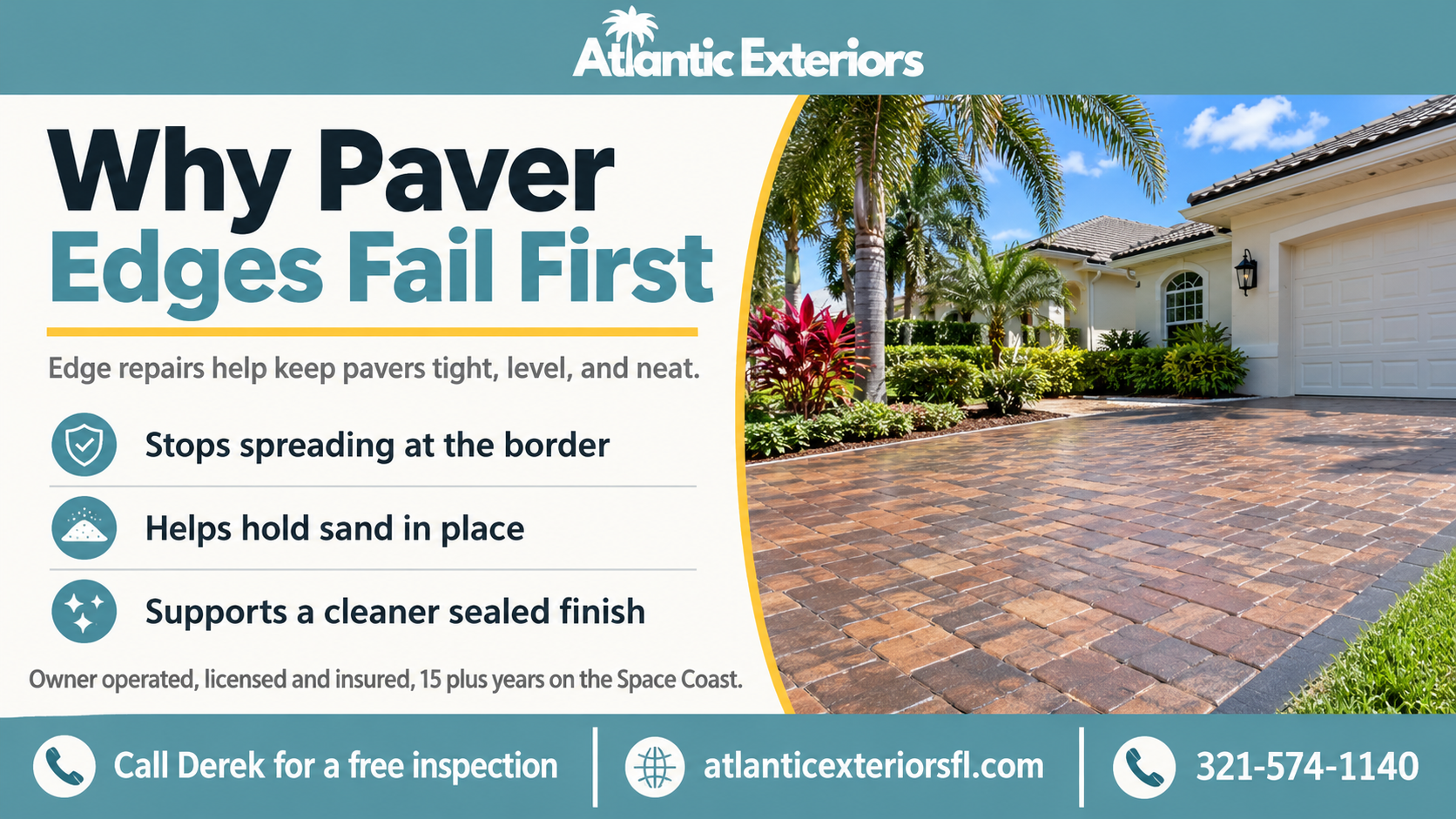
Why edging pavers fail first and how we fix them
Brevard County homeowners and property managers often notice the same thing first: the edge of a paver driveway, patio, walkway, or pool area starts to spread, sink, or look uneven before the rest of the surface does.
That is not random. On the Space Coast, edging pavers take more abuse than almost any other part of the job. They deal with runoff, traffic, Florida heat, afternoon thunderstorms, and plain old wear from daily use. Once the edge starts moving, the problem can slowly work inward.
At Atlantic Exteriors, Derek sees this across Melbourne, Palm Bay, Viera, Rockledge, Merritt Island, Satellite Beach, Indialantic, Indian Harbour Beach, Melbourne Beach, Cocoa Beach, Cocoa, Cape Canaveral, Titusville, and West Melbourne. The good news is that early edge failure can often be repaired before it turns into a much larger restoration project. If you want Derek to take a look, call him directly at (321) 574-1140.
Why the edges fail before the middle
The middle of a paver area is supported on all sides. The edge is not.
That simple difference matters a lot. Edge pavers are the first line against movement. They hold the field of pavers in place, but they also take the brunt of outside pressure.
Common reasons edging pavers fail first include:
- Water washing out sand along the border
- Vehicle tires riding too close to driveway edges
- Foot traffic cutting corners on walkways
- Weak or broken edge restraints
- Soil movement from heavy rain and hurricane season
- Pool splash-out and runoff near pool deck pavers
- Salt air, sun, and humidity wearing materials over time
On a driveway, the outer rows may flex under weight if cars consistently track the same path. On a patio or walkway, the edge can loosen where grass, beds, or open soil meet the pavers. Around a pool, water and cleaning routines can wear on the border faster than people expect.
For commercial properties, edge failure often shows up at storefront entrances, HOA walkways, courtyards, and parking lot paver sealing areas where carts, foot traffic, and delivery activity stay tight to the perimeter.
What edge failure looks like early
Most people do not spot it on day one. They notice small clues.
Signs homeowners should watch for
You may have edging problems if you see:
- A slight spread or gap along the outside row
- Pavers tipping outward
- A low spot near the border after rain
- Joint sand washing out faster at the edge
- Weed growth starting in one section of the border
- A rough feel when walking from one paver to the next
These signs show up on driveways, front walks, patios, and pavers near your pool. In beachside areas like Satellite Beach, Indian Harbour Beach, Indialantic, and Melbourne Beach, salt air and moisture can add to the wear.
Signs commercial properties should not ignore
For business and HOA properties, the warning signs are similar, but the risk is bigger. Uneven border pavers can become trip points. They also make an entrance look worn before the rest of the surface does.
If you manage storefront and business-entrance pavers, HOA and property-manager paver sealing projects, or larger walkways, early repair matters. A small edge issue is easier to fix than a long section that has fully shifted.
Why sealing alone does not fix a failed edge
Paver Sealing is important, but it is not a bandage for movement.
This is where people get frustrated. They may think the surface just needs to be cleaned and sealed again. But if the edging has already moved, sealing over the problem will not correct the cause.
Sealing helps protect pavers and joint sand from weather, sun, and everyday wear. It helps maintain the surface. It does not reset loose pavers, rebuild support, or replace failed edge restraint.
If Derek sees a structural edge problem during a free on-site inspection, he will tell you plainly. Sometimes the right order is repair first, then Paver Sealing after the area is stable again.
That is true for small residential jobs around 500 square feet and for large commercial areas up to 20,000 square feet. The size changes. The repair logic does not.
How Atlantic Exteriors fixes edging pavers
Every job starts with a close look at what actually failed.
Derek personally inspects every project. He looks at the pavers, the border, the sand loss, the support underneath, drainage patterns, and how the area is being used. Then he provides a written quote and explains the repair in plain language.
Step 1: Remove the failed section
Loose or sunken edge pavers are carefully lifted. This lets Derek see whether the problem is limited to the border or has started moving inward.
Step 2: Correct the base and support
If material under the edge has washed out or settled, that area needs to be corrected before the pavers go back. If Derek thinks a deeper issue is involved, he can walk you through it on the free inspection.
Step 3: Reset or replace pavers as needed
Many times, the original pavers can be reset. If some are cracked or too worn, Derek will explain the options.
Step 4: Rebuild the edge restraint
This is a key part of the repair. If the border is not properly held, the same movement can return. The exact fix depends on the layout and condition of the area.
Step 5: Re-sand joints and prepare for Paver Sealing
Once the section is stable again, the joints are re-sanded. Then, if the timing is right, the area can be sealed to help protect the surface and hold up better against Brevard County weather.
After the job, Atlantic Exteriors also does a post-project follow-up. That matters when you want owner-operated service and a direct line to the person doing the work. To talk through your project, call Derek at (321) 574-1140.
Why local conditions on the Space Coast make edge problems worse
Florida weather is hard on pavers, but Brevard County has its own mix of stress.
Sun bakes surfaces for months. Summer UV is strong. Afternoon thunderstorms dump water fast. Humidity stays high. In some areas, salt air adds another layer of wear. During hurricane season, heavy rain and runoff can expose weak spots quickly.
That is why edge maintenance matters so much in places like Melbourne, Viera, Palm Bay, Cocoa Beach, and Titusville. A border that looks only slightly loose today can shift more after one rough weather cycle.
For homeowners, that may mean a driveway edge that starts unraveling. For commercial paver sealing clients, it may mean a business entrance or HOA walkway that starts looking uneven and neglected.
Regular Paver Sealing helps protect the surface, but it works best when the pavers are already sound. In general, sealed pavers often need attention every 2 to 3 years, while pool deck pavers are often closer to 2 years. Covered patios can sometimes go beyond 3. Derek can give you a realistic timeline based on your layout and exposure.
FAQ
Can edging pavers be repaired without redoing the whole area?
Often, yes. If the problem is caught early, the failed border section can sometimes be repaired without rebuilding the entire surface. Derek can confirm that during the free inspection.
How do I know if I need repair or just Paver Sealing?
If the pavers are moving, sinking, spreading, or tipping, repair usually comes first. If the surface is stable but faded and losing joint sand, Paver Sealing may be the next step.
Do you handle both homes and commercial properties?
Yes. Atlantic Exteriors works on residential driveways, patios, walkways, and pavers near your pool, as well as commercial paver sealing for storefronts, HOA walkways, courtyards, and larger parking-area paver sections.
What should I do if I see the edge starting to fail?
The best move is to have it inspected before the damage spreads. Atlantic Exteriors is licensed and insured, and every project includes a free on-site inspection, a written quote, and a post-project follow-up.
If the edge of your pavers is starting to move, call Derek directly at Atlantic Exteriors at (321) 574-1140. He personally inspects every project across Brevard County and the Space Coast. You can also learn more at https://www.atlanticexteriorsfl.com, but the easiest next step is a quick phone call to (321) 574-1140.