Why pavers settle around pools and what fixes it
Brevard County pool owners see this all the time. A few pavers near the pool start to dip. One corner gets loose. Water sits where it did not used to sit. Before long, the area looks uneven and starts to feel unsafe.
Around the Space Coast, from Melbourne and Palm Bay to Viera, Merritt Island, Satellite Beach, and Titusville, pool deck pavers take a beating. Sun, rain, humidity, salt air, and heavy foot traffic all add up. The good news is that settled pavers can usually be fixed. The key is fixing the cause, not just pushing the pavers back into place.
At Atlantic Exteriors, Derek Perreira handles paver sealing and paver repair & restoration for homeowners and commercial properties across Brevard County. If you want a clear answer about what is happening around your pool, call Derek directly at (321) 574-1140.
Why pavers settle around pools
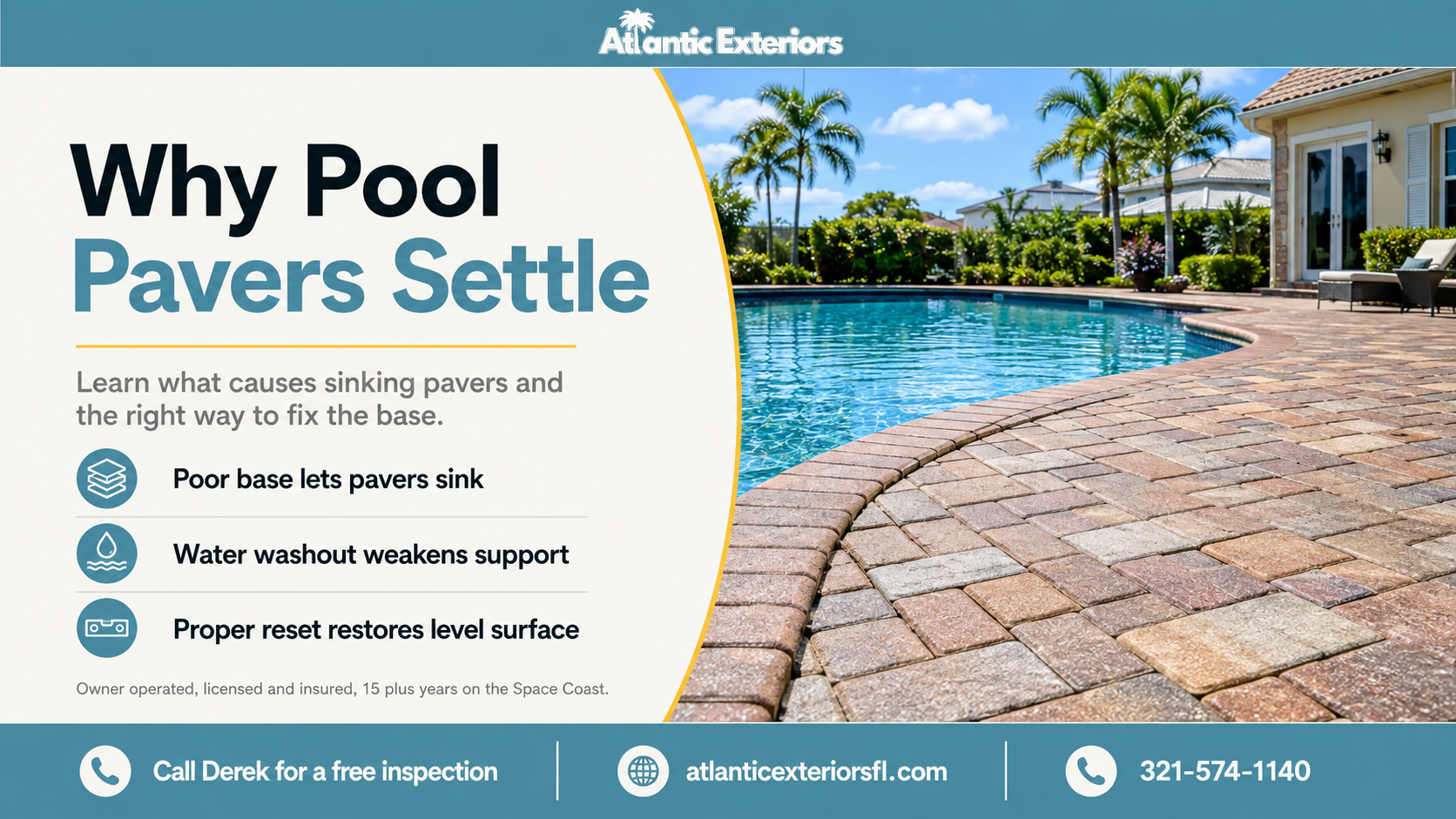
Pavers do not usually settle because the pavers themselves failed. Most of the time, the problem is underneath them.
Around pools, the base under the pavers can shift over time. That can happen for a few common reasons:
- Water washing into the joints and under the pavers
- Poor drainage that keeps the base too wet
- Soil movement from heavy rain and afternoon thunderstorms
- Splash-out from the pool over many months and years
- Deck areas that were not compacted well enough when first installed
- Edge restraint failure, where the outside border no longer holds everything tight
On the Space Coast, weather plays a big role. In places like Indialantic, Indian Harbour Beach, Melbourne Beach, Cocoa Beach, and Cape Canaveral, salt air and moisture are constant factors. In inland areas like Rockledge, Cocoa, West Melbourne, and Palm Bay, summer rain and shifting ground can still cause the same problem.
If the pavers were installed years ago, normal age can also be part of it. Joint sand wears away. Water gets in more easily. Small movement turns into visible settling.
The signs that the problem is getting worse
A lot of homeowners first notice settled pool deck pavers because they feel a wobble underfoot. Others notice standing water after rain or after the pool area is rinsed down.
Common warning signs
Watch for these:
- Low spots that hold water
- Pavers that rock when stepped on
- Uneven edges near coping or borders
- Wider joints in one area than the rest
- Sand washing out after storms
- Trip edges where one paver sits higher than another
These issues are not just cosmetic. Around a pool, uneven pavers can become a slip or trip hazard. That matters for families, guests, and older homeowners.
For commercial properties, the concern is even bigger. HOA pool areas, apartment amenities, hotel-style courtyards, and restaurant patios with poolside pavers need safe, even surfaces. A small settled section can quickly become a maintenance problem that affects appearance and liability.
What does not actually fix settled pavers
This is where people often waste time and money.
If pavers have settled, surface cleaning alone will not fix it. Adding sealer over a low area will not level it. And simply pouring more sand into the joints usually does not solve the real problem if the base underneath has moved.
Paver Sealing is important. It helps protect the surface, supports joint sand stability, and improves the look of the pavers. But sealing is not a substitute for repair when the base has already failed in a spot.
A quick patch can make the area look better for a short time. It usually does not last if the cause was poor drainage, washout, or loose base material.
That is why Derek personally inspects every project. He looks at the surface, the pattern, the surrounding drainage, and how the area is being used. If you are not sure whether you need paver repair, paver sealing, or both, call (321) 574-1140 and Derek can walk you through it.
What actually fixes settled pool deck pavers
The real fix usually involves lifting the affected pavers, correcting the base, and resetting the pavers properly.
A proper repair usually includes
- Removing the sunken or loose pavers
- Checking for washed-out or soft base material
- Rebuilding and re-leveling the base where needed
- Resetting the pavers to the correct height and slope
- Re-sanding the joints
- Recommending Paver Sealing once the area is ready
The exact repair depends on what Derek finds during the free on-site inspection. Sometimes the issue is limited to a small section near the pool edge. Other times, a wider area needs attention because water has been moving through more of the deck than you can see from the surface.
The goal is simple: make the area stable again and help reduce the chance of the same problem coming back.
After repair, Paver Sealing often makes sense as the next step. Sealing pavers near your pool helps protect the surface from weather, supports the joint sand, and gives the deck a cleaner, more finished look. Around pools, sealed pavers also tend to be easier to maintain through Brevard County’s sun, humidity, pollen, and storm season.
Why local conditions matter in Brevard County
Pool areas in Florida deal with conditions that speed up wear. Summer UV is strong. Afternoon thunderstorms are common. Hurricane season can bring heavy rain and runoff. Near the coast, salt air adds another layer of stress.
That is why pool deck pavers on the Space Coast often need more attention than covered patio pavers. In general, Paver Sealing lasts around 2 to 3 years, while pavers around your pool are often closer to 2 years because they face more water, sun, and use.
For homeowners, that means regular inspection matters. For commercial properties, it matters even more. HOA and property-manager paver sealing, storefront and business-entrance pavers, and larger amenity decks all benefit from a maintenance plan instead of waiting for bigger movement to show up.
Atlantic Exteriors handles both small and large jobs, from residential pool decks around 500 square feet to larger commercial and HOA paver areas up to about 20,000 square feet. If you manage a community pool area or a business property with pavers, Derek can inspect it and give you a written quote with a clear scope of work.
When to call for repair instead of waiting
If the area is actively sinking, holding water, or creating a trip edge, it is worth getting it looked at now. Small settled spots are usually easier to correct than larger sections that have been moving for a long time.
A free inspection can also help you avoid doing the wrong service first. Some pool decks need repair before Paver Sealing. Others may be structurally fine and mostly need cleaning, fresh joint sand, and sealing.
Atlantic Exteriors is licensed and insured, and every project includes a free on-site inspection, a written quote, and a post-project follow-up. If you are in Melbourne, Viera, Rockledge, Merritt Island, Cocoa Beach, Palm Bay, or anywhere else in Brevard County, call Derek directly at (321) 574-1140.
FAQ
Why do pavers sink more around pools than patios?
Pool areas get more water, more foot traffic, and more splash-out. That extra moisture can slowly weaken the base under the pavers, especially if drainage is not ideal.
Can Paver Sealing fix uneven pavers?
No. Paver Sealing helps protect and maintain pavers, but it does not level sunken areas. If pavers have settled, the affected section usually needs to be lifted and reset first.
How long does paver sealing last around a pool?
In most cases, about 2 years is a fair expectation for pool deck pavers in Brevard County. Covered areas can last longer, while open pool decks take more weather and wear.
How do I know if my pool deck needs repair or just sealing?
If you see low spots, loose pavers, or standing water, repair may be needed first. Derek can walk you through this on the free inspection.
If your pool deck pavers are settling, shifting, or just looking tired, Atlantic Exteriors can help you figure out the right next step. Derek personally inspects every project and gives honest guidance on repair, restoration, and Paver Sealing. Visit https://www.atlanticexteriorsfl.com or, better yet, call Derek directly at (321) 574-1140 to schedule your free inspection in Brevard County.