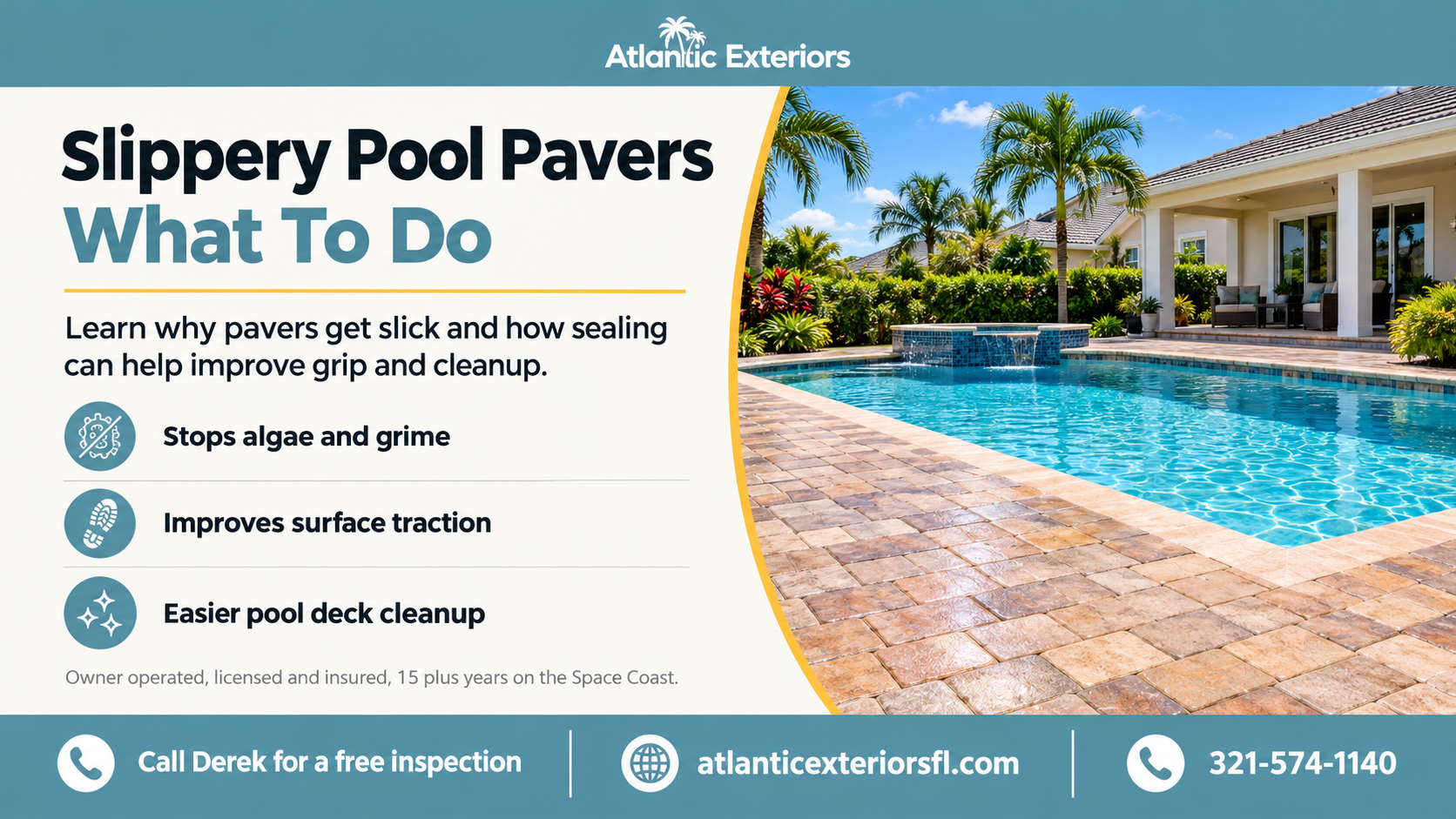
Why pool area pavers feel slippery and what to do
Brevard County pool owners see this all the time. One day your pool deck pavers feel normal. Then after rain, splash-out, or a humid morning, they suddenly feel slick under bare feet.
That slippery feeling usually has a cause you can fix. On the Space Coast, sun, salt air, pollen, afternoon storms, and year-round moisture all work against pavers near the pool. In Melbourne, Palm Bay, Viera, Rockledge, Merritt Island, Satellite Beach, Indialantic, Indian Harbour Beach, Melbourne Beach, Cocoa Beach, Cocoa, Cape Canaveral, Titusville, and West Melbourne, the same pattern shows up again and again.
If your pool area pavers feel slippery, Atlantic Exteriors can help figure out why. Derek personally inspects every project, from smaller residential pool decks to larger HOA and commercial pool areas. You can call Derek directly at (321) 574-1140 for a free on-site inspection and written quote.
The most common reasons pool deck pavers get slippery
Most slippery pavers are not caused by one big problem. It is usually a mix of moisture, surface buildup, and wear.
Here are the most common causes:
- Algae, mildew, or organic growth on the surface
- Pollen, dirt, sunscreen, and body-oil buildup
- Standing water from poor drainage or low spots
- A sealer that has worn unevenly
- A finish that is too glossy for the setting
- Heavy shade that keeps the surface damp longer
Around pools, pavers stay wet more often than driveways or front walkways. That means buildup can form faster. Even if the pavers still look decent from a distance, the surface may be telling a different story underfoot.
For homeowners, this often starts in the same spots: near the pool steps, by the screen door, around the outdoor shower, or in corners that do not get full sun. For commercial paver sealing clients, it can show up around community pool decks, hotel-style seating areas, restaurant patios, and HOA walkways where foot traffic and moisture meet every day.
Why Brevard County weather makes it worse
The Space Coast climate is tough on outdoor surfaces. Heat and humidity do not just make people uncomfortable. They also help slick buildup hang around longer.
Moisture stays around longer than you think
Even when the top of the pavers looks dry, the surface can still hold a thin film of moisture. Add shade, screened enclosures, or a few afternoon thunderstorms, and that damp feeling can stick around.
Salt air also matters, especially beachside in places like Satellite Beach, Indialantic, Indian Harbour Beach, Melbourne Beach, Cocoa Beach, and Cape Canaveral. It can leave residue and add to the general wear on outdoor surfaces.
Summer brings more than heat
Summer UV, humidity, hurricane season rain, and extra pool use all hit at once. That means more water on the deck, more sunscreen and oils on the pavers, and more chances for slippery spots to form.
If you are not sure whether the issue is buildup, drainage, or an old sealer, call Derek directly at (321) 574-1140. He can walk the area with you and explain what he sees in plain language.
How to tell what kind of slippery problem you have
A quick look can tell you a lot.
Signs of surface buildup
You may notice:
- Dark or greenish patches
- A dull, dirty film that does not rinse away easily
- Slippery spots in shaded areas
- A deck that feels worse in the morning or after rain
This usually points to organic growth or residue sitting on the surface.
Signs the sealer may be part of the issue
You may notice:
- Uneven shine from one area to another
- Slicker feel in only a few sections
- Older pavers that have not had paver sealing in a while
- Areas near the pool that wear faster than covered sections
Paver sealing around your pool should help protect the surface, but the wrong look or a worn-out finish can create problems instead of solving them. Pool deck pavers usually need attention sooner than a covered patio. In many cases, paver sealing lasts about 2 to 3 years, while pavers near the pool are often closer to the 2-year mark because of water, sun, and traffic.
What to do about slippery pool area pavers
The right fix depends on the cause. That is why a free on-site inspection matters.
Start with a proper inspection
Do not guess. A slippery pool deck can be caused by more than one issue. Derek personally inspects every project and looks at the surface condition, drainage, wear patterns, and the current state of the pavers and sealer.
Atlantic Exteriors is licensed and insured, and every project includes:
- A free on-site inspection
- A written quote
- Post-project follow-up
Cleaning and restoration may be needed first
If buildup is the main issue, the pavers may need to be properly cleaned and restored before any new paver sealing is considered. If a few pavers have shifted and are holding water, paver repair and restoration may also be part of the solution.
That matters for homeowners, but it also matters for commercial properties. HOA and property-manager paver sealing projects often involve larger shared pool areas, walkways, and courtyards where slick spots can become a safety concern for residents and guests. Atlantic Exteriors handles both small residential jobs around 500 square feet and larger commercial work up to about 20,000 square feet.
Choose the right finish for the setting
Not every pool area should have the same final look. A high-gloss appearance may not make sense near constant water and bare feet. Derek can walk you through what is realistic for your specific pavers during the free inspection.
How paver sealing helps near your pool
Good paver sealing is not just about appearance. It also helps protect the surface from day-to-day wear.
Benefits can include:
- Easier routine maintenance
- Better resistance to water intrusion
- Slower buildup of dirt and residue
- A more even, refreshed appearance
- Protection that fits Florida weather better than leaving pavers exposed
That said, paver sealing is not magic. It still needs to match the condition of the pavers and the demands of the area. Around pools, regular upkeep matters more because the surface sees more water, more bare feet, and more outdoor living.
For businesses, commercial paver sealing can also help maintain a cleaner, more cared-for look at pool decks, business courtyards, and shared outdoor spaces. That is especially useful for HOAs, restaurants, and property managers trying to keep common areas safe and presentable.
When to call a pro
If the pavers feel slick more than once in a while, it is worth getting them checked. The same goes for areas where water sits, where the surface looks blotchy, or where old paver sealing may be failing.
A quick inspection can save time and help you avoid doing the wrong fix. Derek personally handles inspections for homeowners and commercial clients across Brevard County. If you are in Melbourne, Viera, Merritt Island, Titusville, Palm Bay, or beachside communities, call Derek directly at (321) 574-1140.
Atlantic Exteriors serves the Space Coast with owner-operated paver sealing and restoration for homes, HOAs, storefronts, restaurants, and other commercial properties. To talk through your pool deck pavers, visit https://www.atlanticexteriorsfl.com or, better yet, call (321) 574-1140 and speak with Derek directly.
FAQ
Why are my pool deck pavers slippery even when they look clean?
A clear or dull film can still be present even if the pavers do not look dirty. Moisture, pollen, sunscreen, and light organic growth can all make the surface slick.
How long does paver sealing last around a pool?
In many cases, paver sealing lasts 2 to 3 years, but pool deck pavers are often closer to 2 years because they deal with more water, sun, and foot traffic.
Can slippery pavers mean I need repair, not just sealing?
Yes. If low spots are holding water or some pavers have shifted, paver repair and restoration may be needed along with paver sealing. Derek can walk you through this on the free inspection.
Do you handle larger HOA or commercial pool areas too?
Yes. Atlantic Exteriors works on small residential jobs and larger commercial paver sealing projects, including HOA walkways, storefront areas, and shared outdoor spaces up to about 20,000 square feet.