Why two-coat paver sealing lasts longer than one coat
If you are comparing paver sealing options, one question comes up a lot: does a two-coat seal really last longer than a one-coat job?
In many cases, yes.
A two-coat paver sealing job usually gives your pavers better, more even protection. That matters in Brevard County, where sun, humidity, afternoon thunderstorms, salt air, and regular foot or vehicle traffic all work against your surface year-round.
That does not mean every surface needs the exact same approach. Some pavers absorb sealer differently than others. Some older patios need more restoration work before sealing. Some pool deck pavers wear faster because of moisture, chlorine exposure, and constant sun. That is why Derek personally inspects every project at Atlantic Exteriors before recommending a plan.
If you want a clear answer for your driveway, patio, walkway, or pavers near your pool, call Derek directly at (321) 574-1140.
Why one coat often falls short
A single coat can improve color and add some protection. But on many Florida paver surfaces, one coat does not always give full, even coverage.
Pavers are porous. They soak in sealer at different rates depending on age, condition, sun exposure, and prior maintenance. One area may absorb quickly while another area holds more product near the surface.
That can lead to a few common problems:
- Uneven protection across the surface
- Less consistent color enhancement
- Faster wear in traffic paths
- More exposure to sand joint loss after heavy rain
- Shorter overall lifespan before resealing is needed
This is especially noticeable on driveways in Melbourne, Palm Bay, West Melbourne, and Viera, where daily vehicle traffic puts more stress on the surface. A one-coat job may still look decent at first, but it often does not hold up as long under real use.
What the second coat actually does
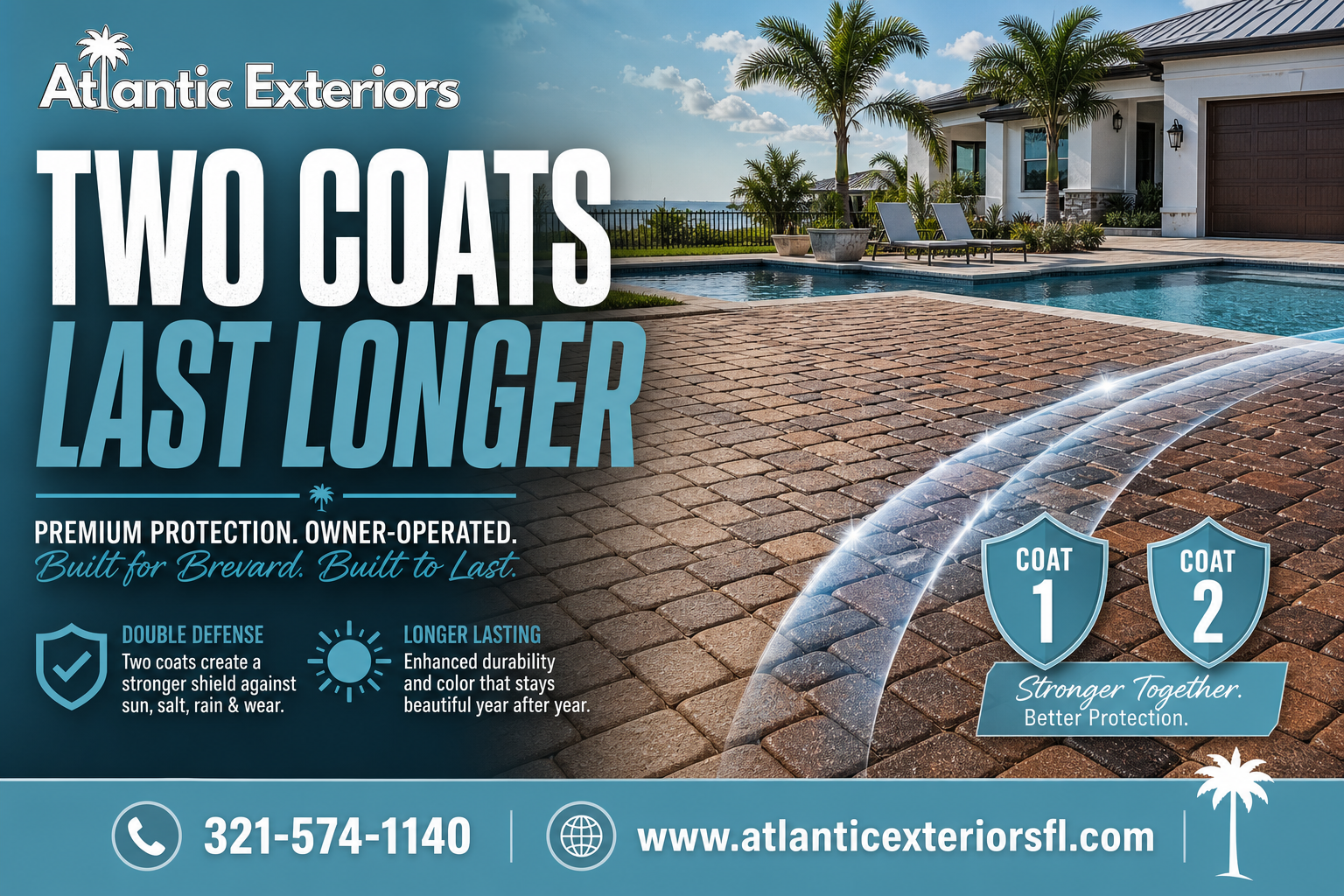
The second coat is not just “more sealer.” It helps complete the coverage.
Think of the first coat as the base layer that starts soaking into the pavers and joint areas. The second coat helps even things out and build a more complete protective layer where the first coat absorbed quickly.
Better coverage on porous pavers
Older brick pavers, faded patios, and sun-beaten driveways often drink in that first coat fast. The second coat helps make sure the surface is not left underprotected.
That is a big deal in places like Rockledge, Merritt Island, Titusville, and Cocoa, where long sun exposure and seasonal storms can age pavers faster than many homeowners expect.
More consistent finish
A two-coat paver sealing job often gives a more uniform appearance. That means fewer dull spots and less patchiness.
For homeowners, that matters because the surface does not just need to be protected. It should also look cared for.
Better durability over time
No sealer lasts forever. In Florida, paver sealing typically lasts around 2 to 3 years. Pavers near your pool are often closer to 2 years because of water, sun, and regular use. Covered patios can stretch beyond 3 years in some cases.
But when coverage is more complete from the start, the surface usually holds up better over that lifespan.
Why Florida conditions make two coats more important
Florida is hard on outdoor surfaces.
In Brevard County, your pavers deal with:
- Summer UV and heat
- High humidity
- Afternoon thunderstorms
- Hurricane season rain and wind
- Pollen buildup
- Salt air near the coast
If you live in Satellite Beach, Indialantic, Indian Harbour Beach, Melbourne Beach, Cocoa Beach, or Cape Canaveral, that coastal exposure can be especially tough on pavers. Even inland areas like Palm Bay and Viera still see intense sun and moisture swings.
With all of that going on, thin or uneven protection tends to show its age sooner.
Pool areas are a good example
Paver sealing around your pool is one of the clearest cases for proper coverage. Pool deck pavers face water, foot traffic, sunscreen residue, and strong UV. A one-coat job may not give those pavers enough lasting protection.
That does not mean every pool area automatically gets the same method. Derek can walk you through this on the free inspection. But in general, a two-coat approach often makes more sense where wear is higher.
If you are not sure what your pavers need, call Derek directly at (321) 574-1140. He will give you a straightforward opinion.
When a two-coat job makes the most sense
Not every project is identical. But a two-coat paver sealing job is often the better choice when:
- The pavers are older or very dry
- The color has faded from sun exposure
- The surface gets heavy driveway traffic
- The patio gets strong afternoon sun
- The pavers near your pool stay damp often
- The home is near the ocean and exposed to salt air
- The last sealing job wore off faster than expected
Homes in Melbourne, Cocoa, Merritt Island, and Melbourne Beach often have a mix of these conditions. A driveway may need one level of protection, while a covered lanai needs another.
That is why Atlantic Exteriors does a free on-site inspection and provides a written quote before any work begins. Derek personally inspects every project, and the company is licensed and insured.
Good prep still matters just as much
Two coats help, but prep work matters too.
If the surface is not properly cleaned, if repairs are skipped, or if joint sand issues are ignored, adding extra sealer will not fix those underlying problems. Good paver sealing starts with honest inspection and proper prep.
That is one reason homeowners across Brevard County call an owner-operated company instead of looking for the fastest possible job. The goal is not just to make pavers shiny for a week. The goal is to help them hold up better over time.
Atlantic Exteriors also includes a post-project follow-up, which gives homeowners extra peace of mind after the work is done.
The real question is value, not just coat count
The cheapest option is not always the best value.
If a one-coat job needs attention sooner, or if the finish wears unevenly, it may not save much in the long run. A well-executed two-coat paver sealing job often gives better staying power, especially on exposed Florida surfaces.
If you live in Palm Bay, Rockledge, West Melbourne, Viera, or anywhere in Brevard County, Derek can tell you whether your pavers truly need one coat or two. No guessing. No pressure. Just a clear recommendation based on what he sees in person.
Call (321) 574-1140 to schedule a free inspection.
FAQ
Does two-coat paver sealing always last twice as long?
No. It is not a simple doubling effect. But two coats often provide more complete coverage and better durability than one coat, especially on porous or weathered pavers.
How long does paver sealing usually last in Florida?
Most paver sealing lasts about 2 to 3 years in Florida. Pavers near your pool are often closer to 2 years. Covered patios can sometimes last beyond 3 years.
Is two-coat paver sealing better for driveways?
Often, yes. Driveways usually take more abuse from vehicle traffic, heat, rain, and daily use. Derek can inspect your pavers and recommend the right approach.
How do I know what my pavers need?
The best way is a free on-site inspection. Derek personally inspects every project, provides a written quote, and explains what makes sense for your specific pavers.
If you want honest advice about paver sealing from a local owner-operator, call Derek at Atlantic Exteriors at (321) 574-1140. You can also learn more at https://www.atlanticexteriorsfl.com, but the easiest next step is to pick up the phone and talk with Derek directly.